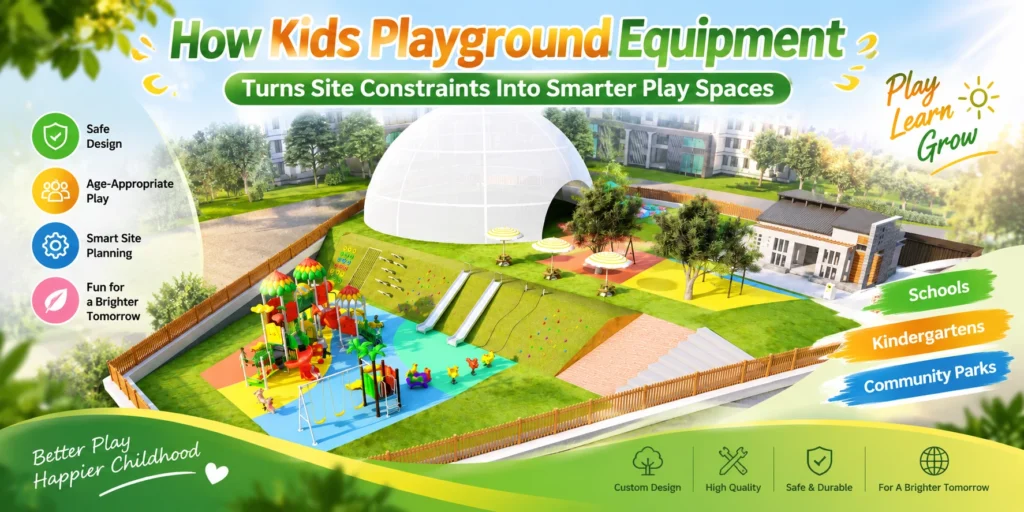
Specifying play equipment for a school, kindergarten, or community park rarely fails on ideas. It stalls on detail: which structures suit which age group, what the site allows, and how delivery and installation fit a fixed term. Distributors face the same question at scale.
Kids playground equipment covers swing sets, climbers, slides, freestanding structures, and modular systems that link into towers, decks, and access routes. Units are sized by age band, surfacing depth, and use capacity.
The sections below map categories, age zones, and build-or-buy costs — the checks that separate one kids playground manufacturer quote from another.
Kids Playground Equipment Categories: Swing Sets, Climbers, Slides, and Freestanding Structures
Category selection comes before configuration. Product pages typically sort inventory into four groups, and buyers filter down fast:
- Swing sets and playsets — 1–3 bays as standard; add a bay, swap a baby seat for a belt seat, or adjust deck height between roughly 0.9 m and 1.5 m.
- Slides — straight, spiral, or double-lane; platform heights step in 0.3 m increments, and spirals need more footprint for the same drop.
- Climbers — climbing walls, nets, and dome frames, chosen mainly by age band.
- Freestanding structures — towers, decks, and modular systems, plus add-ons such as bridges, roofs, and activity panels.
Most buyers shortlist two categories, then configure inside one. Hold deck height, slide type, and post diameter constant across quotes — a school playground manufacturer comparison only works when the specification matches. Age suitability then narrows the shortlist.
Playground Equipment by Age Zone: 2-5, 5-12, and All-Ages Configurations
Once the specification is fixed, the age band decides what actually fits. Deck heights, use zones and supervision sightlines shift sharply between a 2-5 and a 5-12 build, and a line labelled 2-12 rarely suits every child in that range.
| Age zone | Typical equipment | Site considerations |
|---|---|---|
| 2-5 | Decks under 1.2 m, toddler slides, ramps, sensory panels | Enclosed layout, one clear sightline, 1.5 m use zones |
| 5-12 | Swing sets, overhead ladders, 2.0-2.5 m decks, climbing nets | Deeper surfacing, wider fall zones, circulation space |
| 2-12 / all-ages | Linked modular systems, duplicated entry points | Physical separation, shared seating, phased install |
Mixing zones works when entry points are separated and paths allow two-way traffic; a fenced 2-5 area beside a taller 5-12 structure keeps toddlers clear of swing arcs. Ask any kindergarten playground manufacturer which age band each line is engineered for, not just the headline range. Zone split fixed, build versus buy is next.
Build vs Buy a Playset: Cost, Lead Time, and Options for Project Buyers
For kids playground equipment, buying a modular kit usually wins on speed and budget certainty. Build from raw steel or timber only when site levels, fall zones, or a bespoke theme rule out catalogue parts. Cost drivers stay similar: steel gauge, timber species, deck height, slide length, and swing bay count.
| Factor | Build | Buy |
|---|---|---|
| Cost | Higher labour, split freight | Fixed kit price, lower site labour |
| Lead time | 10–16 weeks | 2–6 weeks standard; 6–12 weeks custom |
| Customisation | Any geometry, higher design cost | Module, colour, panel choices |
| Installation | 3–5 days, multiple trades | 1–2 days, two fitters |
Source components carefully if you build; swings, slides, and clamps must match load ratings and fixing centres. Kit suppliers carry that risk. Catalogue kits deliver in 2–6 weeks; custom builds add 3–6 weeks for powder coating, moulded slides, or hardware. Installation: two fitters need 1–2 days for a kit; site builds need 3–5 days and multiple trades.
Leasing or staged payments suit schools and councils. Distributors gain margin by holding kit stock; contractors prefer buying to fix labour. For indoor, outdoor, or water play, an ODM kids playground manufacturer can blend catalogue frames with custom panels.
Custom, OEM, and ODM Playground Manufacturing: Indoor, Outdoor, and Water Play Builds
Custom work splits into three build types, each with different tooling and lead-time risk:
- Indoor soft play — padded frames, ball pits, and slides sized to ceiling height and floor area; foam density and vinyl thickness shift by age zone.
- Outdoor structures — powder-coated steel posts, HDPE panels, swing and climber modules cut to the site footprint.
- Water play — non-slip decking, splash pads, and pump-fed features specified around drainage and near-constant wet use.
OEM keeps the drawing and artwork with you; the factory produces to your file. ODM adapts existing moulds and cut files, then applies your logo, colour and packaging. Distributors and contractors building mixed catalogues often buy from a kids indoor playground manufacturer and a kids outdoor playground manufacturer in parallel, so standardise colour codes and panel artwork across both. A single RFQ can cover all three lines. Lock steel gauge, foam density and surface finish before tooling opens, then map the standards each build must evidence.
Safety Standards and Procurement Evidence for Commercial Playground Equipment
Before you order, request the documents a site inspector will read. Reviewers check three things: whether the structure suits the intended age zone, whether falls are managed, and how long parts last. Ask for the whole pack in one go.
- Age-zone fit. Layout drawings grouping equipment for 2-5, 5-12, or all-ages use, with clear sight lines.
- Fall protection. Critical fall height per item, surfacing depth, and free-space envelope around each unit.
- Accessibility. Transfer platforms, ramp gradients, and unitary surfacing routes.
- Durability. Steel gauge, galvanised or powder-coat finish, HDPE panel thickness (often 15-19 mm), UV ratings.
- Low maintenance. Spare parts list, fastener schedule, replacement intervals.
Match the pack against your age zone playground design drawings before signing, and confirm added modules arrive with the same paperwork.
About JQ Playground – kidsplaygroundmanufacturer.com
JQ Playground (Wenzhou Jiqi Amusement Equipment Co., Ltd.) is a children’s playground equipment manufacturer founded in 1993. The company provides design, customization, large-scale manufacturing, sales, installation guidance, and after-sales support for outdoor playgrounds, indoor playgrounds, soft play, water playgrounds, PE board playgrounds, kindergarten furniture, outdoor fitness equipment, pet playgrounds, and playground facilities. Approved company facts include 180+ employees, a large Wenzhou production base, 20+ production lines, 55 production machines, ISO/BSCI/EN1176/EN71/ASTM/CPC/CPSIC certification references, 100+ patents, free design support, OEM/ODM capability, trial installation before shipping, export experience, and one-year quality warranty.