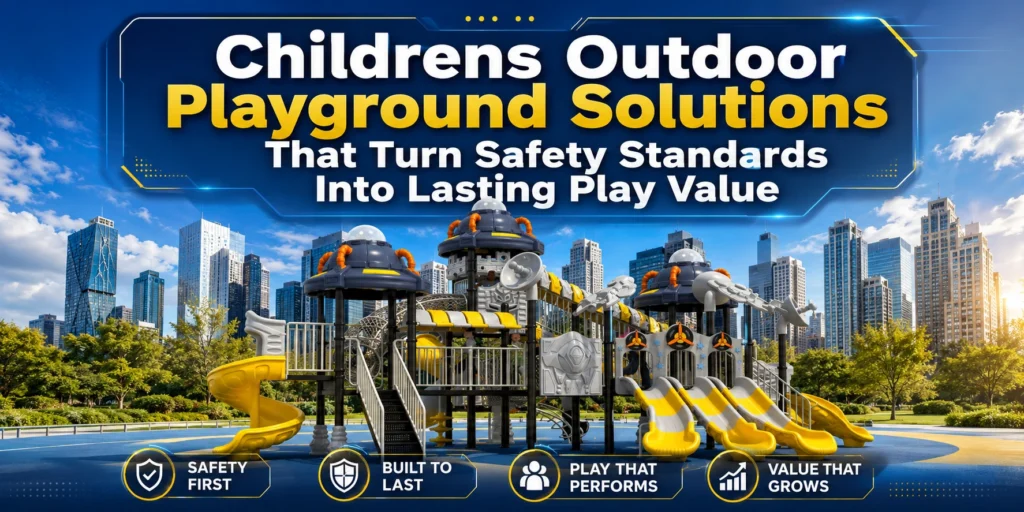
For childrens outdoor playground, buyers need guidance that matches the exact query intent before comparing suppliers, specifications, or RFQ details.
You’re specifying a children’s outdoor playground for a school or public park. The equipment must hold up to daily use by dozens of children while reducing injury risk. Over 60% of commercial playground projects require equipment that meets both EN 1176 and ASTM F1487 safety standards. Getting the durability and safety balance wrong leads to early replacement and liability exposure.
A children’s outdoor playground is a structured play area designed for kids, featuring slides, swings, climbers, and interactive elements, typically installed in schools, parks, or communities.
To choose the right setup, you need to evaluate the product categories available from specialist kids playground manufacturer and children playground manufacturer suppliers — the next section covers each type and its best-fit commercial application.
Overview of Children’s Outdoor Playground Product Categories for Commercial Projects
Modular Playgrounds
Modular systems use pre-engineered components that bolt together on site. This category suits schools and community parks where budget and timeline are tight. A typical configuration might include a 2.4 m slide, net climber, and 3.6 m deck height with three activity panels. Buyers get predictable lead times and easy expansion when funding allows later phases.
Custom Playgrounds
Custom design gives project owners control over shape, materials, and branding. You work with a supplier from early concept to prototype — useful for kindergarten chains that want a consistent look across multiple sites. Example: a castle-shaped climber with the facility’s logo cast into the deck. Expected lead times run longer (8–16 weeks) and MOQs are higher, but the result is a one-off installation that differentiates the venue.
Themed Playgrounds
Themed sets follow a storyline — pirate ships, fire stations, or jungle treetops. They are common in destination playgrounds, holiday parks, and visitor centres. A pirate ship theme might include a mast climber, gangplank balance beam, and steering wheel panel. The challenge for buyers: themed components often require proprietary moulds, so replacement parts may be supplier-specific.
Inclusive Playgrounds
Inclusive equipment is designed for children of all abilities. Key features include ramp-accessible decks, extra-wide slides, and ground-level activity panels. Example: a wheelchair-height sand table plus a low-transfer platform that connects to a traditional slide. For council-funded projects or school accessibility upgrades, inclusive play areas are increasingly mandated.
Essential Safety Standards and Certifications for Playground Equipment Sourcing
Beyond inclusive design requirements, compliance with recognised safety standards is non-negotiable for any commercial playground project. These certifications cover critical hazards such as impact-attenuating surfacing, entrapment risks, and structural integrity.
- ASTM F1487 (United States) – This standard specifies performance requirements for playground equipment regarding entrapment, protrusions, and head and neck clearance zones. It also mandates use zones and fall surfacing depths.
- EN 1176 (European Union/UK) – The European playground equipment standard covers structural safety, impact attenuation, and accessibility. It includes specific tests for swing seats, slide exits, and climbing net tension. If you are sourcing for a European site, verify that the equipment carries a CE mark backed by EN 1176 compliance.
- CSA Z614 (Canada) – Similar in scope to ASTM F1487, this Canadian standard addresses surfacing, guardrails, and ladder design. Municipal parks and school boards across Canada typically mandate CSA Z614 certification.
- AS 4685 (Australia/New Zealand) – Used in Oceania, this standard harmonises with EN 1176 but includes region-specific adjustments for UV resistance and high-wind anchoring. Suppliers exporting to Australia should provide documented AS 4685 test reports.
Choosing equipment that meets the relevant standard for your target market minimises legal exposure and signals quality to end clients. Always request a certificate of conformity and third-party test report before finalising your order.
Custom Design and OEM Options for Large-Scale Playground Installations
For projects requiring a distinctive identity, custom design and OEM options let you tailor every element to your exact brief. The process follows a clear sequence.
- Initial consultation and site assessment. You share the project scope – space dimensions, age range, theme, and any branding elements. The manufacturer provides feasibility feedback on structural and safety constraints.
- Concept design and 3D rendering. A design team produces CAD visuals showing layout, colour schemes, and play components. For example, JQ Playground, with an 8-person design team, offers free CAD-based playground design based on your site size.
- Engineering and prototyping. Structural drawings are finalised, and a physical prototype of the most complex elements is built. This step validates assembly and safety compliance.
- Pre-production sample and approval. A full or partial sample unit is produced for your review. You check finish quality, colour accuracy, and fit before the production run starts.
Typical MOQs range from 20 units for a single custom configuration to 100+ for multi-variant orders. Lead times run 6–10 weeks from design sign-off to shipment. Cost drivers include material choice, design complexity, and order volume. Customisation raises unit cost by 15–30% compared to standard modular sets.
Real-world example: A kindergarten chain commissioned a bespoke playground incorporating its brand colour and mascot. The manufacturer produced a prototype within three weeks, adjusting platform heights and adding sensory elements. The final installation was delivered in two batches over six weeks. JQ Playground, with over 100 patents and constant R&D, regularly supports such OEM/ODM projects, offering free modification drawings and suggestions.
The benefit is clear: a custom design differentiates your project, reinforces brand identity, and creates a memorable play experience that off-the-shelf equipment cannot match.
Key Considerations When Sourcing Children’s Outdoor Playgrounds from Manufacturers
When reviewing bids from a kids outdoor playground manufacturer, structure your evaluation around a clear checklist.
Pricing and quotes
Request an itemised RFQ that lists equipment, surfacing, freight, installation, and taxes separately. Many suppliers offer tiered pricing: MOQ discounts often kick in at 10–25 units. Ask about payment terms — a typical split is 30% deposit, 70% before shipment. Avoid suppliers who demand full payment upfront.
Warranty and after-sales support
Standard structural warranties run 5–10 years for galvanised steel frames and 1–3 years for plastic components. Confirm whether the warranty covers corrosion, UV fading, or labour for replacements. JQ Playground provides a one-year quality warranty for all products with free after-sales service, including defective part replacement.
Installation and shipping
Installation costs range from 20% to 30% of equipment price. Ask if the manufacturer provides installation manuals, on-site supervision, or a turnkey service. JQ Playground can send engineers to your country for assembly and provides trial installation before shipping, ensuring correct assembly.
Sample policies
Reputable manufacturers offer sample slides, swing seats, or colour chips for a refundable deposit (usually £100–£500). Return the samples within 14 days after placing a production order to reclaim the deposit. Avoid suppliers who cannot provide physical samples.
Supplier verification
Request factory audit reports (ISO 9001, safety certification) and at least three trade references from buyers in your region. JQ Playground, with a 60,000 sqm production base, 55 production machines, and 8 QC checkpoints covering the full production flow, holds certifications including EN1176, ASTM, and CPC. A quick video call to walk the production line often reveals real capacity. Verifying compliance before signing can save significant costs in the long run.
For first-time buyers, send your RFQ to three to five shortlisted manufacturers. Compare not just prices but warranty periods, lead times, and sample availability. A higher-priced bid with a longer warranty and included installation is often cheaper over the project lifecycle.
About JQ Playground – kidsplaygroundmanufacturer.com
JQ Playground (Wenzhou Jiqi Amusement Equipment Co., Ltd.) is a children’s playground equipment manufacturer founded in 1993. The company provides design, customization, large-scale manufacturing, sales, installation guidance, and after-sales support for outdoor playgrounds, indoor playgrounds, soft play, water playgrounds, PE board playgrounds, kindergarten furniture, outdoor fitness equipment, pet playgrounds, and playground facilities. Approved company facts include 180+ employees, a large Wenzhou production base, 20+ production lines, 55 production machines, ISO/BSCI/EN1176/EN71/ASTM/CPC/CPSIC certification references, 100+ patents, free design support, OEM/ODM capability, trial installation before shipping, export experience, and one-year quality warranty.