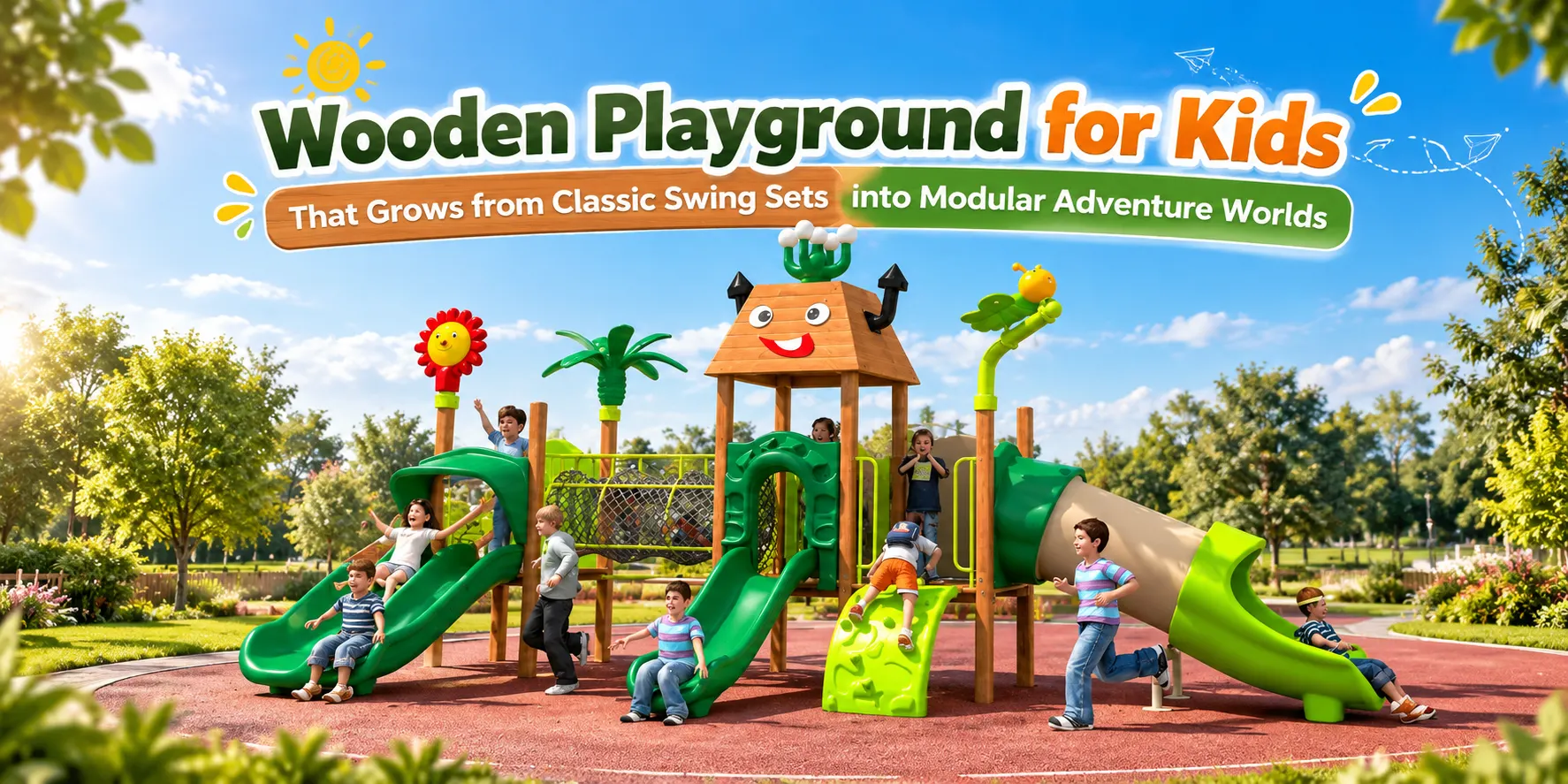
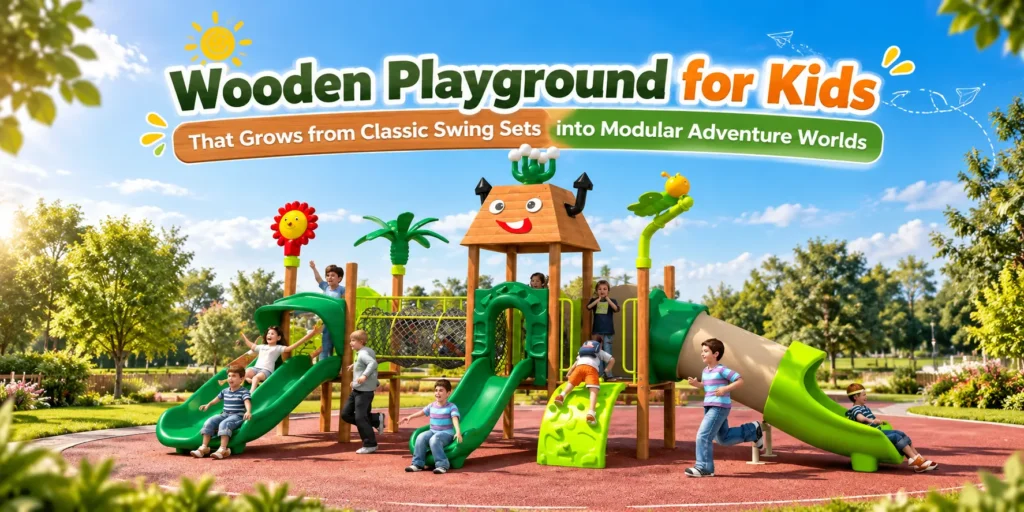
Procurement teams comparing a wooden playground for kids usually start with a shortlist of formats rather than a single product. You might weigh outdoor swing-set frames against indoor wooden play frames, then test configurable playsets against fixed designs for schools, community sites and retail programmes. The comparison turns on footprint, age range, sightlines, component mix and how easily the set can be extended later. A children playground manufacturer can help clarify those trade-offs, but the category map should come first.
A wooden playground for kids is a wood-framed play structure with climbing, sliding, swinging or imaginative-play components, supplied as a fixed or modular set for outdoor or indoor use.
The sections below map the main formats, configurations and material choices buyers typically compare.
Wooden Playground Formats: Swing Sets, Castle Playsets, and Clubhouse Structures
Most retail collections and brand catalogues sort wooden playsets into five buying categories. The table below shows what each typically includes and where it fits.
| Category | Typical components | Buyer use case |
|---|---|---|
| Wooden swing sets | A-frame or ladder frame, 2–3 swing positions, glider or baby seat | Backyard retail, family gardens, small community plots |
| Castle playsets | Tower platforms, crenellated walls, climbing wall, slide, lookout deck | Upscale backyard programmes, themed hospitality and park projects |
| Clubhouse playsets | Enclosed lower level, windows, door, upper deck, ladder or rock wall | Gardens and school yards needing imaginative-play space plus shade |
| Slide-and-climber combos | Slide, rope or rock climbing section, horizontal bars, monkey rungs | Schools and kindergartens balancing active and upper-body play |
| Indoor wooden frames | Low climbing frame, rings, rope steps, movable bars, soft mat zone | Kindergartens, playrooms, retail showroom displays |
Castle and clubhouse formats dominate upscale backyard and community projects for two practical reasons. First, they combine climbing, sliding and imaginative play in one footprint, so a single structure serves ages roughly 3 to 10. Second, an enclosed lower level gives visible supervision points and natural shade — useful where a school playground manufacturer must show duty staff clear sightlines. Expect footprints of 4–6 m² for clubhouse models versus 8–12 m² for three-position swing sets with slide towers. Buyers weighing a kids playground equipment manufacturer’s range should confirm whether platform heights and add-on points are modular before committing to a theme.
Indoor and Outdoor Configurations: Components, Natural Wood Benefits, and Siting
A wooden playground for kids usually combines gymnastic rings, rope steps, swing ropes, movable bars, slides and horizontal bars. Confirm every fixing point can be re-tensioned and checked, because ring and rope assemblies move under load.
Indoor soft-use frames for kindergartens and playrooms sit lower and often fit 6–10 m²; a kindergarten playground manufacturer may confirm compact layouts. Outdoor backyard or community structures need 15–30 m² once fall zones are included, so a custom kids playground manufacturer may plan wider run-outs. Natural wood feels warmer and less slippery than coated metal, yet pale timber can heat on south-facing decks; site slides and platforms in partial shade.
- Indoor fit: low platforms, soft flooring, 1.2–1.5 m clear routes, close supervision.
- Outdoor fit: ground anchors, drainage, 1.5–2 m run-outs at slides and swings, visible sightlines.
Those fixings then depend on timber species and hardware quality.
Cedar, Rot-Resistant Lumber, and Hardware Details That Affect Service Life
Service life hinges on species, fixings, finish and water management. Compare these four signals before approving a sample.
| Material or hardware factor | Why it matters | Buyer check |
|---|---|---|
| Rot-resistant cedar or similar lumber | Slows moisture and insect attack; board thickness limits warping | Confirm species, 19–38 mm boards and knot size |
| Heavy-duty hardware | Swing hangers and bolts carry repeated loads; mild steel corrodes outdoors | Check hot-dip galvanised or stainless fixings and bolt diameter |
| Sanding and finish quality | Rough edges splinter and break down coating | Check 120–150 grit, eased edges and sealed end grain |
| Moisture detailing | Trapped water and soil contact drive rot | Inspect post caps, ground clearance, drainage and ventilated joints |
Set quarterly hardware checks and re-seal exposed frames every 12–24 months. For an OEM kids playground manufacturer brief, state species, fixing grade and finish in one specification so samples compare like for like. These choices also shape how cleanly a frame takes castle panels, roofs and add-on accessories.
Castle, Clubhouse, and Accessory Combinations for Modular Project Builds
Castle and clubhouse themes set the visual story, but the modular platform decides how far you can adapt it. Choose a deck height and footprint that match your age band: a 1.2 m platform suits 5–7s with closer supervision, while a 1.5 m deck adds challenge for 8–12s if sightlines stay clear. Fix bolt patterns and panel spacing early so future roofs or activity panels fit without drilling.
- Slides: 1.2–2.4 m chute lengths tied to deck height.
- Climbing walls: 0.9–1.5 m panels with handholds.
- Activity panels: steering wheels, tic-tac-toe, chalkboards.
- Add-ons: roofs, sandboxes, binoculars, trapeze bars.
A configurable wooden playground for kids is more practical than a fixed build when funding arrives in phases or one frame must serve mixed ages. Confirm build-or-buy capacity and whether local permit rules treat the structure as an accessory or permanent fixture.
About JQ Playground – kidsplaygroundmanufacturer.com
JQ Playground (Wenzhou Jiqi Amusement Equipment Co., Ltd.) is a children’s playground equipment manufacturer founded in 1993. The company provides design, customization, large-scale manufacturing, sales, installation guidance, and after-sales support for outdoor playgrounds, indoor playgrounds, soft play, water playgrounds, PE board playgrounds, kindergarten furniture, outdoor fitness equipment, pet playgrounds, and playground facilities. Approved company facts include 180+ employees, a large Wenzhou production base, 20+ production lines, 55 production machines, ISO/BSCI/EN1176/EN71/ASTM/CPC/CPSIC certification references, 100+ patents, free design support, OEM/ODM capability, trial installation before shipping, export experience, and one-year quality warranty.