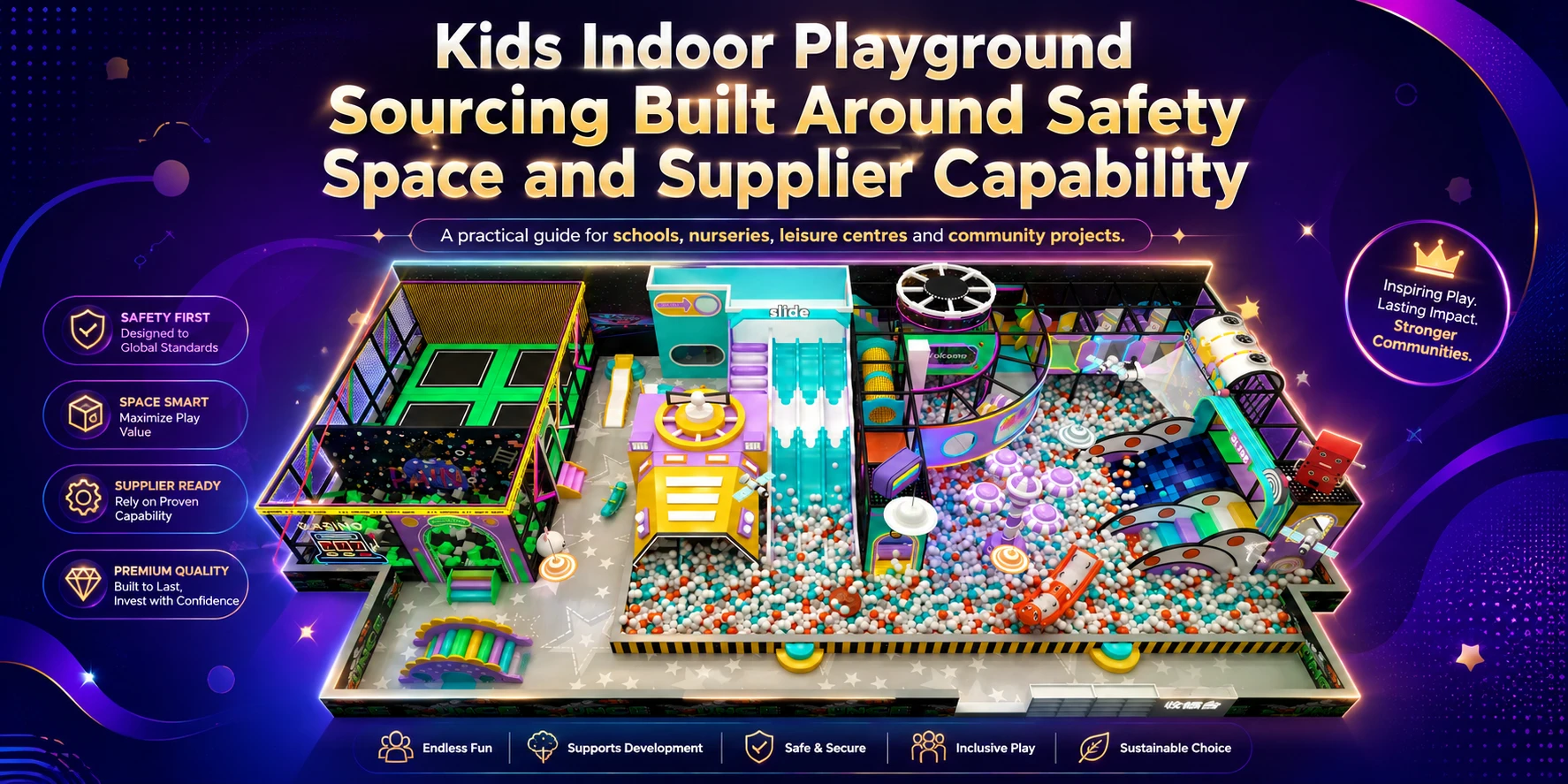
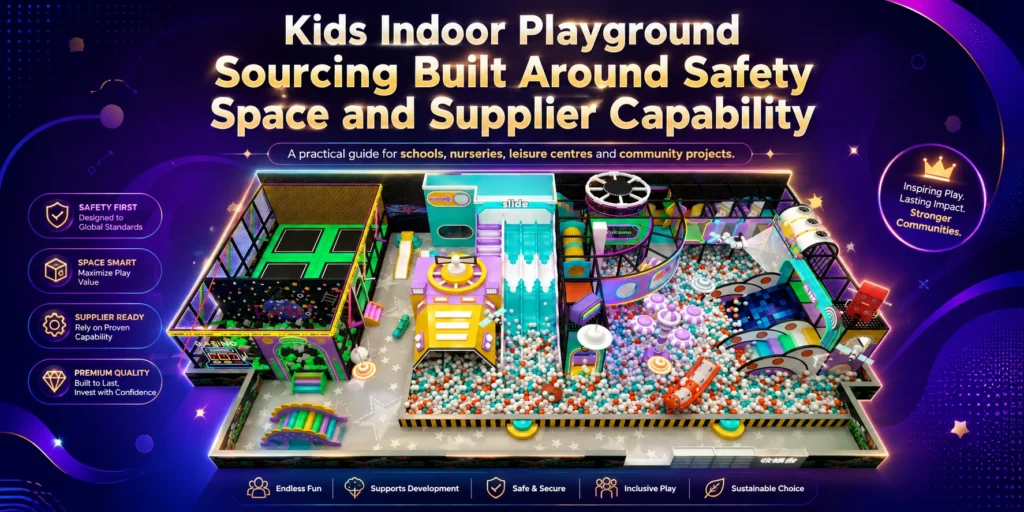
Sourcing a kids indoor playground for a school, nursery chain or community project means juggling safety rules, floor space, age ranges and a budget that never quite stretches. One wrong specification delays your opening and puts children at risk. Too many buyers discover late that suppliers differ sharply in component quality, lead times and inspection support. Replacing a poorly built climbing frame mid-project is costly and disruptive. This guide answers those questions directly: you will learn how indoor playgrounds work, what to compare before sending an RFQ, and how to shortlist a reliable kids playground manufacturer.
A kids indoor playground is a contained, weather-independent play area built from climbing frames, slides, tunnels, ball pits and soft play elements. It is designed for children to run, climb and jump safely under supervision, with padded flooring, safety netting and age-zoned layouts. Commercial versions are supplied as modular kits, which allows schools, nurseries, restaurants and leisure centres to customise size, capacity and theme.
The following section covers how a kids indoor playground works and the checks a children playground manufacturer must satisfy.
How Kids Indoor Playground Works
A kids indoor playground runs on a simple loop: entry, supervised play, transition, exit. Audit any supplier’s design against this sequence:
- Entry and decompression — a soft landing zone absorbs first-rush energy and gives staff clear sightlines.
- Age-zoned play — separate toddler and junior zones prevent collisions and match motor skills.
- Vertical transitions — netted climbs, tunnels, and slides move children between levels without pinch points.
- Supervised exit — one-way flow with visible staff points reduces lost children and queueing.
Component roles in the play sequence
Panels and posts form the skeleton; mats absorb falls; nets contain movement; slides control speed. Each part must pass EN 1176-type impact tests for your market before you order. Ask the kids playground equipment manufacturer for drop-height data per zone during RFQ, not after installation.
Buyer warning: request fall-height figures per component zone. A single blanket certificate rarely covers every platform, slide, and access point.
Next, compare component types to confirm your indoor application fit.
Kids Indoor Playground Components and Product Types
Indoor playgrounds ship as modular component systems, so the category you choose drives price, installation time, and safety paperwork. Compare these five core types before requesting a quote.
| Product type | Typical age fit | Buyer check before RFQ |
|---|---|---|
| Soft play structures | 0–6 years | Foam density and cover seam strength |
| Modular climbing frames | 3–12 years | Load rating and anchor points |
| Ball pits | 2–8 years | Ball volume per m² and hygiene spec |
| Interactive sensory panels | All ages | Wiring safety and replaceable parts |
| Safety flooring and padding | All ages | Impact-absorbing thickness and fire rating |
Specification details worth confirming:
- Foam core density (typically 18–25 kg/m³) and PU leather versus PVC cover wear resistance.
- EN 1176 compliance certificates and fire-retardancy test reports.
- Tool-free access panels for cleaning and replacement part availability.
Your target venue, floor area, and visitor age range determine the final specification.
Typical Applications for Kids Indoor Playground
Soft play centres and family entertainment venues. High-traffic floor plans suit modular foam structures with ball pits and slides. Ask for stain-resistant, fire-retardant covers and EN1176 test reports before placing the order.
Schools and kindergarten chains. Low-height platforms, padded edges, and sensory panels suit ages 2-6. Specify non-toxic materials and request cleaning-protocol documentation for daily rotation between groups.
Community centres and church halls. Multi-use spaces need foldable or zone-based layouts so the same floor doubles as an event hall. Confirm dismantling time and storage dimensions with your OEM kids playground manufacturer.
Pop-up and trampoline parks. Mixed-age areas require separate zones with impact-absorbing mats under climbing frames.
Match footfall, age range, and venue size against supplier capability before you commit. That fit check feeds directly into the custom manufacturing and OEM cooperation process.
Custom Kids Indoor Playground Manufacturing and OEM Cooperation
Once the fit check narrows your specification, the OEM path turns your drawings or reference photos into a priced, testable product. A capable kids indoor playground manufacturer should follow a clear, stage-by-stage process.
| Stage | Buyer input | Manufacturer output |
|---|---|---|
| 1. Design review | CAD drawings, photos, or an existing sample | Feasibility notes and itemised quote |
| 2. Sample confirmation | Approval of materials, colours, and play features | Pre-production sample with test photos |
| 3. Packaging plan | Logo, carton size, and export requirements | Packing specification and labelling proof |
| 4. Batch inspection | Internal or third-party inspection checklist | Lot inspection report and photos before loading |
| 5. Shipment | Delivery window and port destination | Loading list, shipping marks, and tracking updates |
Inspection detail worth requesting
Ask for a pre-shipment check covering weld joints, edge radius, anchor points, and net tension — the failure points most likely to surface after installation. Agree the pass-fail criteria in writing before batch production begins.
When you compare kids indoor playground manufacturer options next, use the inspection report and sample record as equal-ranking evidence.
Top 10 Kids Indoor Playground Manufacturers and Supplier Fit
No single kids indoor playground manufacturer suits every purchasing team. Project scale, theme complexity, and whether you need design, installation, and after-sales services under one contract all change the right match. The table below compares four common supplier types; use it to shortlist candidates, then score each one with the checklist underneath. For distributors and school project contractors, documentation quality and lead-time fit weigh as heavily as price.
| Supplier type | Pros | Cons | Best fit |
|---|---|---|---|
| Turnkey full-service manufacturer | Single contract for design, build and installation; safety sign-off included | Higher upfront cost; longer lead times | Kindergarten chains and community developers needing managed delivery |
| Custom OEM fabricator | Bespoke themes and exact dimensions; tight material control | Larger minimum orders; drawings required before quoting | Distributors and school contractors with repeat specifications |
| Modular climbing and soft-play specialist | Fast assembly; flexible layouts; easy retrofits | Limited theming; standardised footprints | Operators refreshing zones or adding new age groups |
| Budget import supplier | Lowest unit prices; wide standard range | Certification and spare parts can be inconsistent | Price-led buyers with simple, urgent requirements |
Checklist for shortlisting:
- Request itemised safety certificates for every component, not just the main frame.
- Confirm documented age zone playground design for 0-3, 3-6, and 6-12 age bands.
- Match production and installation lead time to your planned opening date.
- Check spare-part availability, maintenance manuals, and local service coverage.
- Treat the approved sample as the gate before batch production.
Source from a child safe playground manufacturer that prices safety documentation into the core quote.
About JQ Playground – kidsplaygroundmanufacturer.com
JQ Playground (Wenzhou Jiqi Amusement Equipment Co., Ltd.) is a children’s playground equipment manufacturer founded in 1993. The company provides design, customization, large-scale manufacturing, sales, installation guidance, and after-sales support for outdoor playgrounds, indoor playgrounds, soft play, water playgrounds, PE board playgrounds, kindergarten furniture, outdoor fitness equipment, pet playgrounds, and playground facilities. Approved company facts include 180+ employees, a large Wenzhou production base, 20+ production lines, 55 production machines, ISO/BSCI/EN1176/EN71/ASTM/CPC/CPSIC certification references, 100+ patents, free design support, OEM/ODM capability, trial installation before shipping, export experience, and one-year quality warranty.