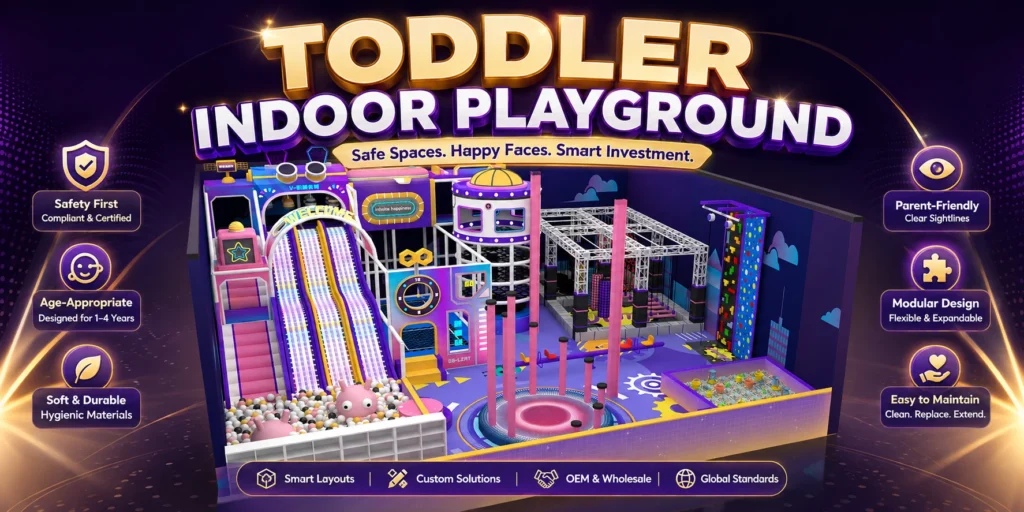
Every buyer knows the sinking feeling: a play area that looks charming in a brochure but fails a safety audit within weeks of install. Poorly specified toddler equipment can mean pinch-point injuries, peeling coatings and non-compliant fall surfacing — headaches that land on you, not the supplier. You need structures engineered for children aged roughly one to four, with rounded edges, small-part safeguards and impact-absorbing mats. This guide explains how indoor toddler play systems work, their components, typical applications and what to verify before commissioning a kids playground manufacturer.
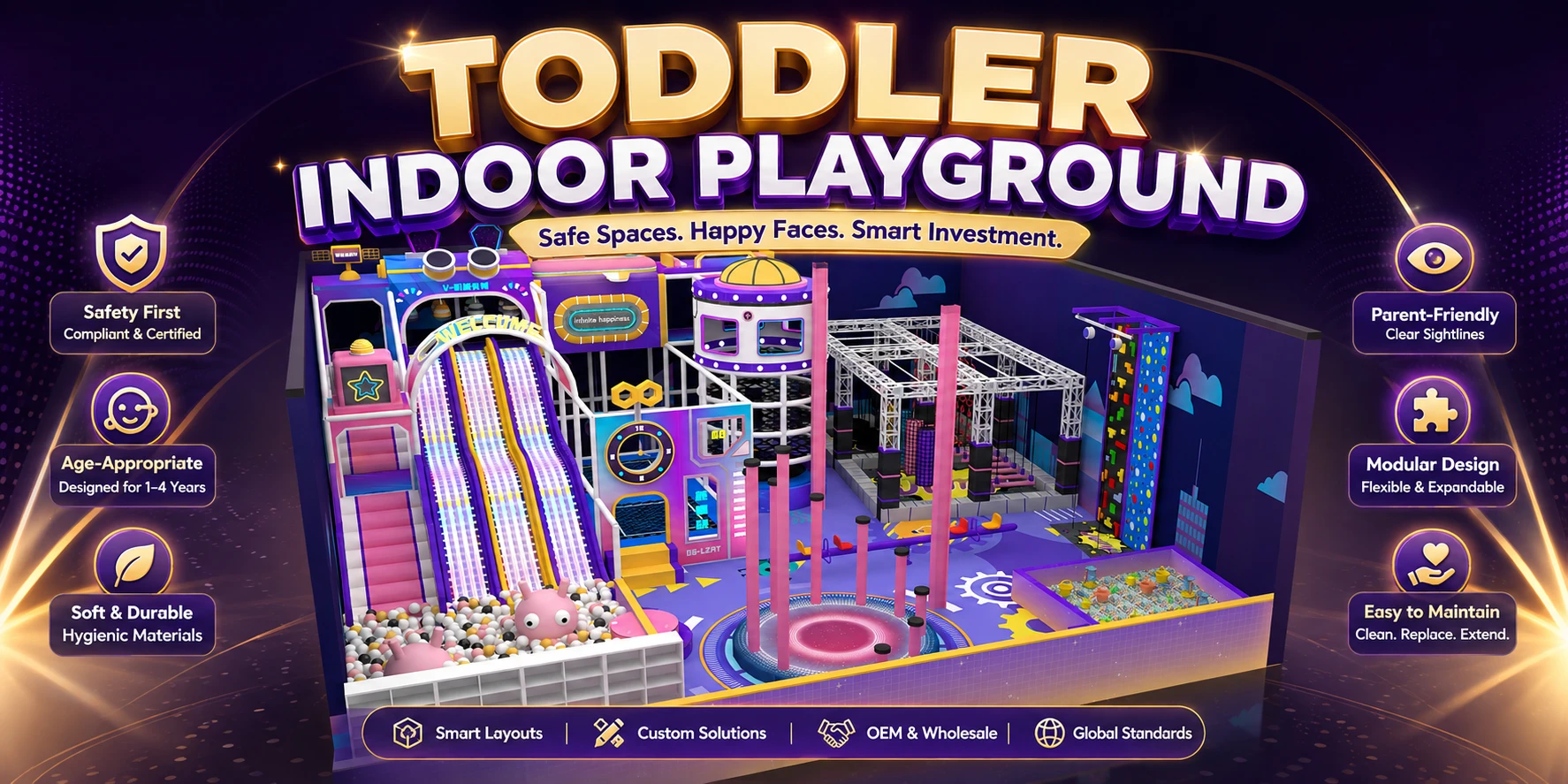
A toddler indoor playground is an indoor play structure designed specifically for children aged roughly one to four years. It typically includes soft climbing blocks, ball pits, low slides, foam hurdles and sensory panels sized for small hands. Units are built from hygienic, impact-absorbing materials such as EPE foam or coated plywood, with rounded edges and secure anchoring to prevent tipping. Indoor placement protects toddlers from weather while giving parents clear sightlines. Commercial versions must meet local playground safety standards for fall height, entrapment, hygiene and fire resistance.
Next, we look at how a toddler indoor playground works in daily operation.
How Toddler Indoor Playground Works
When children enter, a toddler indoor playground runs on a repeatable daily flow.
- Entry control — a gate limits access to the play zone and gives staff a headcount.
- Supervised zones — soft play structures and ball pits sit in clear sightlines.
- Rotation — stations are cleaned or swapped on a timetable to prevent crowding.
- Exit — a one-way route eases collection and stops toddlers wandering.
Each step matches a buyer check. Entry control sets daily capacity and staffing. Zone layout determines safety clearance and matting. Rotation affects spare equipment needs. Exit design shapes insurance inspections.
Component Roles
Climbing platforms, slides, ball pits and padding arrive as separate modules. A kids playground equipment manufacturer should supply parts that assemble without sharp edges or pinch points.
Buyer warning: reject any supplier that cannot document maintenance intervals for joints and foam cores.
Toddler Indoor Playground Components and Product Types
Component choice dictates how a toddler indoor playground survives daily use, so compare product families before requesting quotes.
| Product type | Typical role | Buyer check |
|---|---|---|
| Soft play modules | Foam steps and climbing blocks | Foam density; removable covers |
| Slides and ball pits | Low-gradient slides, ball pools | Edge radius; ball count per m³ |
| Sensory panels | Mirror, sound, texture boards | Child-safe fixings |
| Crawl tunnels | Connecting zones for under-threes | Clear internal space; airflow |
Then check specification details in writing:
- Specify PU or EVA density; denser foam holds shape longer.
- Covers must be double-stitched, removable and washable.
- Check ball size, anti-static finish, and pit depth.
- Verify colour-fastness; confirm floor plans for custom kids playground manufacturer quotes.
Typical Applications for Toddler Indoor Playground
Typical toddler indoor playground installations follow four buying patterns, each with distinct component fit, batch sizes and quality checks.
- Day nurseries and pre-schools. Low-height modular units with ramps, tunnels and ball pits suit ages one to four; standardised layouts help staff rearrange rooms between sessions.
- Soft-play centres and family entertainment venues. Heavy daily footfall demands dense commercial-grade foam and replaceable covers; ask for abrasion-test data and spare-part lead times before agreeing batch quantities.
- Shopping malls, cafés and community centres. Compact, visible zones reduce supervision cost. Check the footprint drawing against your floor plan and confirm fire-rated materials at quotation.
- Kindergarten chains and school project contractors. One standardised design across sites trims procurement time. Request colour-matched samples and same-batch consistency records before approving production.
Once the product family matches the application, customisation depth and OEM cooperation define the next stage.
Custom Toddler Indoor Playground Manufacturing and OEM Cooperation
A custom toddler indoor playground order runs a defined route: your drawings or reference sample triggers the quote; packaging choices then lock the specification. The table shows who supplies what at each gate.
| Stage | Buyer input | Manufacturer output |
|---|---|---|
| Quotation | CAD drawings, product photos, or a reference sample plus target quantity | Feasibility check, material schedule, and itemised quote |
| Sample approval | Sign-off on colour, dimensions, and fixing points | Corrected pre-production sample |
| Packaging | Logo, carton quantity, and marking language | Packing plan with container loading data |
| Batch inspection | AQL threshold and defect definitions | Pre-shipment report and photos |
| Shipment | Delivery date and destination port | Packing list and shipping documents |
Inspection hold points
Agree the acceptable quality limit before mass production starts. Buyers typically set AQL 2.5 for safety-critical measurements and check edges, gaps, and fastener torque on a per-container sample. Supplier fit is decided at this gate.
Top 10 Toddler Indoor Playground Manufacturers and Supplier Fit
Ranking lists suit SEO more than procurement. For toddler indoor playground equipment, shortlist by supplier type before comparing brand names.
| Supplier type | Pros | Cons | Best-fit |
|---|---|---|---|
| Turnkey design-build manufacturer | One accountable partner; custom age-zone playground design | Premium cost; longer timeline | Kindergarten chains and community builds |
| Modular soft play specialist | Faster install; foam shapes suit 1–3-year-olds | Lower play capacity; pads compact with hard use | Day-care centres and toddler cafes |
| Steel-and-deck structure maker | Durable and scalable for mixed ages | Standard models can miss toddler sightlines | Venues with separate toddler zones |
| OEM contract manufacturer | Branded colours and logos; volume pricing | You manage design and quality control | Brands and distributors with own drawings |
Scoring checklist:
- Verify third-party safety reports for the exact model quoted.
- Request a 3D layout or sample panel before purchase.
- Get spare-part supply and install lead time in writing.
- Judge responsiveness at quote stage; it predicts issue handling.
Sourcing principle: the cheapest quote fails most on delivery, inspection access, or age-zone design gaps. Score those before negotiating price.
About JQ Playground – kidsplaygroundmanufacturer.com
JQ Playground (Wenzhou Jiqi Amusement Equipment Co., Ltd.) is a children’s playground equipment manufacturer founded in 1993. The company provides design, customization, large-scale manufacturing, sales, installation guidance, and after-sales support for outdoor playgrounds, indoor playgrounds, soft play, water playgrounds, PE board playgrounds, kindergarten furniture, outdoor fitness equipment, pet playgrounds, and playground facilities. Approved company facts include 180+ employees, a large Wenzhou production base, 20+ production lines, 55 production machines, ISO/BSCI/EN1176/EN71/ASTM/CPC/CPSIC certification references, 100+ patents, free design support, OEM/ODM capability, trial installation before shipping, export experience, and one-year quality warranty.