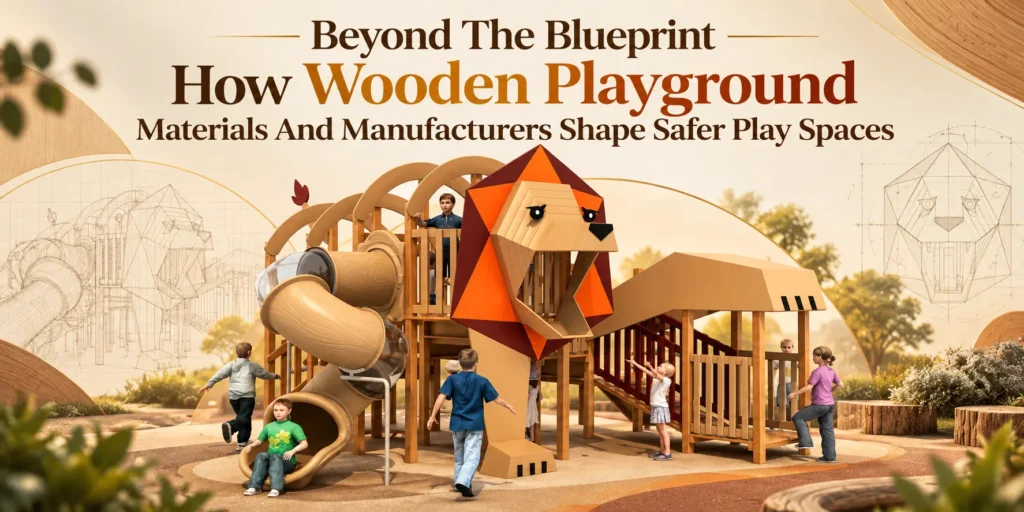
Specifying a wooden playground looks straightforward until quotes come back 40-60% apart. Timber species, post diameter, hardware grade and fall-height compliance drive most of that gap. Buyers who approve a drawing alone often receive structures that fail on-site inspection. This guide covers component categories, realistic applications and the checks to run before you contact any children playground manufacturer.
A wooden playground is a play structure whose main frame, decks and climbing elements are built from timber — commonly pine, cedar, redwood or robinia — rather than steel or plastic. Posts are anchored in concrete footings or steel bases, joined by galvanised or stainless brackets, and topped with roofs, slides and swing bays. Design follows safety standards such as EN 1176 or ASTM F1487, which set fall heights, guardrail heights and impact-absorbing surfacing depths. Timber is sanded, rounded and either pressure-treated or naturally rot-resistant.
Next, we explain how a wooden playground is assembled and what each stage means for your sourcing decision.
How Wooden Playground Works
A wooden playground works in four repeatable stages:
- Ground prep and footings — posts sit in concrete or steel brackets to hold a level deck.
- Frame and deck build — treated timber posts, beams and joists carry the platform load.
- Play module fixing — swings, slides, climbing walls and roofs bolt onto the frame.
- Safety check — fall zones, edge radius and hardware torque are verified before handover.
Component roles
Posts carry vertical load. Beams and joists spread it. Brackets resist sway, and fasteners tie the assembly together. Two buyer checks matter most: state your application and age group so a kids playground equipment manufacturer can size members correctly, and confirm fall-height ratings against your surfacing before approving drawings.
Ask for the inspection record for every batch, not just the first sample.
Repeat orders stay safe only when member sizes, hardware spec and surfacing depth match the approved sample.
Wooden Playground Components and Product Types
Buyers shortlist wooden playground ranges by component family first. Two quotes for the same swing frame often hide different post diameters, bolt grades and fixing packs, and that gap shows up on site.
| Product type | Main components | Buyer check before RFQ |
|---|---|---|
| Swing frames | A-frame legs, top beam, hangers, chains or ropes | Beam span against seat count; hanger spacing |
| Climbing units | Posts, rungs, climbing panels, rope nets | Rung diameter and gap spacing; fall height |
| Slide towers | Platform decks, guardrails, slide chute | Deck height; slide exit height above surfacing |
| Playhouses and shelters | Wall panels, roof boards, floor sections | Panel thickness; roof fixing points |
| Add-on accessories | Sandpits, steering wheels, telescopes, benches | Compatibility with existing post diameter |
Specification details to fix in writing:
- Timber: species, moisture content, planing direction and edge radius.
- Hardware: bolt grade, galvanised or stainless finish, recessed heads, tamper-resistant fixings.
- Connectors: bracket type and post diameter, so parts mate across repeat batches.
- Finish and packing: sanding grit, stain coats, flat-pack labels and one hardware bag per unit.
A kindergarten playground manufacturer and a custom kids playground manufacturer quote from the same list, so send component names, not just play value.
Typical Applications for Wooden Playground
Four buyer groups drive most wooden playground demand, and each one changes the specification you should confirm before ordering.
- Schools and kindergartens: single-deck units, rounded post edges and 1.2–1.5 m platform heights for ages 3–6. Ask for fastener grade and post-cap closeout details.
- Community and municipal parks: multi-deck towers with slide and swing add-ons; confirm timber species, deck loads and ground-fix method.
- Residential and hospitality: compact redwood or cedar sets for gardens and terraces; check panel dimensions, colour stain and hardware corrosion class.
- OEM and ODM brands: private-label climbing frames and swing modules, where an OEM kids playground manufacturer or ODM kids playground manufacturer confirms tooling, logo placement and carton limits.
Typical batch sizes run from one set for a home to 20–50 units per school rollout, so state quantity, age band and fixings up front.
Those application details become the drawings and material calls we work from next.
We design and install custom redwood playsets for families in DFW and nationwide.
Custom redwood playsets start from your site photos, sketches or a sample unit, not a fixed catalogue. Send platform height, footprint, slide or swing positions, timber grade and finish colour, and you get a drawing set with a quoted build. Kids outdoor playground manufacturer buyers often order a single bay, yet the same path holds at higher volume.
| Stage | You provide | We return |
|---|---|---|
| Drawings or samples | Sketch, photo or sample playset; footprint; user age band | Dimensioned drawing, timber section list, load-point notes |
| Quote | Target quantity, timber grade, colour, packaging style | Itemised quote with lead time |
| Sample confirmation | Approval or marked-up changes | Revised sample plus signed drawing for the batch |
| Packaging | Carton or pallet preference, label artwork | Packing plan and carton marking proof |
| Batch inspection | Priority checks: joints, hardware, sanding | Per-batch inspection record before release |
| Shipment | Delivery address and schedule window | Booking confirmation and loading photos |
What batch inspection covers
Ten assemblies per batch are checked for joint tightness, splinter-free sanding and hardware counts against the approved sample. Anything outside that sample is reworked before loading.
Compare suppliers on how tightly they hold these stages.
Top 10 Wooden Playground Manufacturers and Supplier Fit
A ten-name shortlist usually collapses into four supply models. Match the model to your project before comparing unit price.
| Supplier type | Pros | Cons | Best fit |
|---|---|---|---|
| Nordic/European timber specialists | EN 1176 test files; graded timber | 12–16 week lead times; higher unit cost | Public parks, kindergarten chains |
| Asian OEM/ODM play factories | Low cost above 200 units; colour and logo work | Species varies per quote; slow samples | Private-label distributors, OEM buyers |
| Regional fabricators | Site survey; fast replacement parts | Narrow range; no full catalogue | Single-region school refits |
| Catalogue distributors | Low minimums; ready stock | Little design input; stacked margins | Retailers testing a first wooden range |
Score each candidate on:
– Load ratings and EN 1176 or ASTM F1487 evidence per component.
– Written timber species, treatment class and moisture content.
– Batch repeatability: does order two match sample one?
– Spare-part supply and RFQ reply speed.
– Can a child safe playground manufacturer mark age zone playground design zones on drawings?
Price ranks last; supply model decides whether a project finishes on schedule.
About JQ Playground – kidsplaygroundmanufacturer.com
JQ Playground (Wenzhou Jiqi Amusement Equipment Co., Ltd.) is a children’s playground equipment manufacturer founded in 1993. The company provides design, customization, large-scale manufacturing, sales, installation guidance, and after-sales support for outdoor playgrounds, indoor playgrounds, soft play, water playgrounds, PE board playgrounds, kindergarten furniture, outdoor fitness equipment, pet playgrounds, and playground facilities. Approved company facts include 180+ employees, a large Wenzhou production base, 20+ production lines, 55 production machines, ISO/BSCI/EN1176/EN71/ASTM/CPC/CPSIC certification references, 100+ patents, free design support, OEM/ODM capability, trial installation before shipping, export experience, and one-year quality warranty.