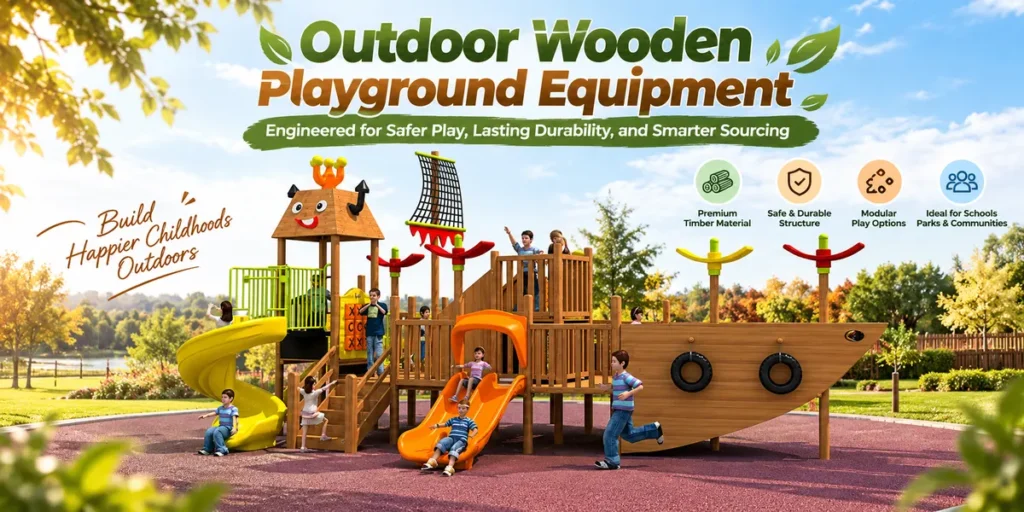
Specifying outdoor wooden playground equipment for a school, park or family venue often stalls on the same worries: timber that splinters within a season, frames that fail wind or weight loads, and play values that flatten once children outgrow the first layout. A weak specification shows up as closed play zones, parent complaints and repeat repair invoices. The fix is to lock the wood species, fixing method, safety clearances and growth plan into the brief before you compare quotes from any kids playground manufacturer.
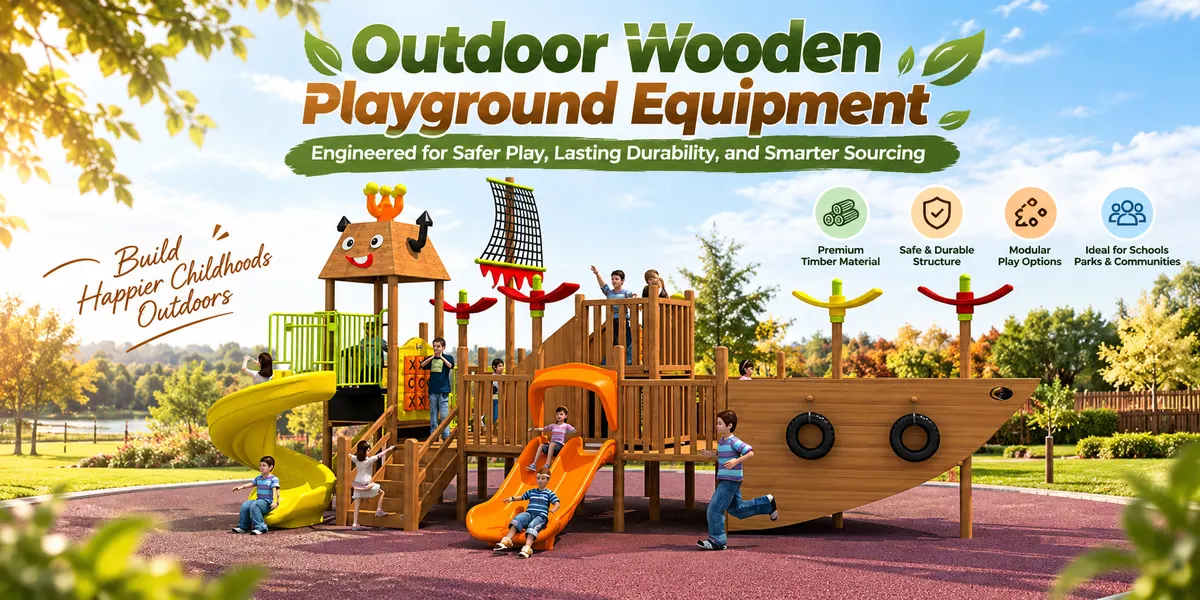
Outdoor wooden playground equipment is a category of play structures built mainly from timber—posts, decks, towers, roofs, climbing walls, swing frames and slides—installed in gardens, nurseries, schools, parks and community spaces. Buyers define it by wood species, treatment class, age group, play value, fixing method, safety clearances and intended lifespan.
The sections below explain how these structures work, which components to compare and how custom builds are specified.
How Outdoor Wooden Playground Equipment Works
Outdoor wooden playground equipment works as a load-transfer system: play forces travel from the child through the deck or seat, into the posts, and down to footings that spread weight into the ground.
- Frame and footing. Timber posts are set in concrete or surface anchors, sized to the unit’s height and user load.
- Platform and bracing. Decks, joists and diagonal braces tie the posts together so movement in one bay is resisted by the whole structure.
- Play modules. Slides, swings, climbing walls and towers bolt to the frame at rated fixing points.
- Surface and fall zone. Engineered wood fibre or rubber surfacing absorbs impact across the required safety area.
Each step maps to a buying check. Confirm the age group and user count match the frame’s duty rating. For schools, ask a school playground manufacturer for the load and fall-height figures before ordering. Ask any kids playground equipment manufacturer how footing depth is specified for your soil. Repeatability matters too: the same drawing should produce the same fixing layout across every batch, so spare parts fit later replacements.
Buyers who skip the fall-zone plan often discover the surfacing cost exceeds the structure cost after delivery.
Outdoor Wooden Playground Equipment Components and Product Types
Before an RFQ, separate the structure into four buyable groups. Each carries different specification risk.
| Product type | Core parts | Buyer check |
|---|---|---|
| Timber swing sets | 90–120 mm posts, crossbeams, bracket plates | Post spacing against swing bay width |
| Climbing frames | Ladders, rungs, climbing walls, handrails | Rung diameter and grip spacing |
| Multi-play towers | Platforms, roofs, slides, tunnel links | Platform height versus age band |
| Modular add-ons | Sandpits, play panels, balance beams | Fixing compatibility with existing posts |
Specification details to confirm in writing:
- Timber grade and finish: species, moisture content, sanded edges, coating system.
- Fixing hardware: galvanised or stainless bolts, recessed heads, covered caps.
- Connectors: steel corner brackets, ground anchors, post bases.
- Safety extras: guardrail heights, slide run-out length, fall-zone footprint.
A kindergarten playground manufacturer supplying modular kits usually quotes these as separate line items, which makes comparison cleaner. Request part drawings per group, not a single lump price.
Typical Applications for Outdoor Wooden Playground Equipment
Application scenarios for outdoor wooden playground equipment rarely share one specification. A kindergarten for ages 3–6 and a public park differ on deck height, connector set, and batch size. Match product choice to site use.
- Schools and kindergartens: Lower platforms, enclosed decks, and rounded handholds suit supervised play for ages 3–6. Confirm bracket spacing, connector fit, bolt covers, and fixing plates match the surfacing depth and post size. For 5–20 set batches, request per-set packing lists and timber batch records.
- Community parks and housing developers: Higher towers, climbing walls, and swing frames need galvanised connectors and concrete footings. Ask for load-path drawings, hardware salt-spray evidence, and staged delivery schedules for phased handover.
- Distributors and OEM kids playground manufacturer buyers: Modular kits and colour/logo options support range building. Compare carton dimensions, spare-part ratios, and pre-shipment inspection photos across 20–50 unit orders.
These patterns form the brief for custom manufacturing, where drawings and samples become batch production.
Custom Outdoor Wooden Playground Equipment Manufacturing and OEM Cooperation
Your applications brief becomes a production spec through a defined exchange. For custom outdoor wooden playground equipment, each stage pairs your input with a checkable manufacturer output.
| Stage | You provide | Manufacturer returns |
|---|---|---|
| 1. Brief | Drawings or sample, timber species, age group, target quantity | Feasibility note, material options, draft specification |
| 2. Quote | Packaging style, delivery window, sample expectations | Itemised cost, lead time, sample fee |
| 3. Sample | Sign-off criteria, logo or colour requirements | Pre-production sample, finish reference |
| 4. Packaging | Carton marks, pallet limits, unloading method | Prototype carton, packing list |
| 5. Batch | Inspection checklist, AQL level | Batch record, loading photos |
| 6. Shipment | Shipping terms, document list | Packing list, bill of lading draft |
Inspection Detail to Confirm
Check timber moisture content sits between 8% and 12%, then confirm treatment coverage on cut ends and fastener pull-out resistance on one sample per batch. Request dated photographs before pallet wrapping.
Documented outputs at each stage give you like-for-like quotes when shortlisting outdoor wooden playground equipment manufacturers.
Top 10 Outdoor Wooden Playground Equipment Manufacturers and Supplier Fit
Rank the ten shortlisted manufacturers by supplier type, not catalogue size. Those documents narrow the field; fit still depends on project scale, compliance evidence, and replacement-part support.
| Supplier type | Pros | Cons | Best fit |
|---|---|---|---|
| Timber play specialists | Test reports, durable hardwood | Higher cost, longer lead times | School and public tenders |
| Integrated play systems | Broad modules, spare-parts support | Less bespoke timber detailing | Kindergarten chains |
| Regional joinery workshops | Fast prototypes, small batches | Variable finish consistency | Community projects |
| Volume OEM factories | Low unit cost at scale, custom packaging | Setup time, minimum batches | Distributors and private-label ranges |
Score each candidate on:
– Test reports for the applicable play standard and fall height.
– Timber species, moisture content, treatment, and fixing quality.
– Age zone playground design matched to your site and user group.
– Replacement-part lead time and packaging durability.
– Whether the child safe playground manufacturer can repeat batch quality.
These scores give you a comparable basis for final selection.
About JQ Playground – kidsplaygroundmanufacturer.com
JQ Playground (Wenzhou Jiqi Amusement Equipment Co., Ltd.) is a children’s playground equipment manufacturer founded in 1993. The company provides design, customization, large-scale manufacturing, sales, installation guidance, and after-sales support for outdoor playgrounds, indoor playgrounds, soft play, water playgrounds, PE board playgrounds, kindergarten furniture, outdoor fitness equipment, pet playgrounds, and playground facilities. Approved company facts include 180+ employees, a large Wenzhou production base, 20+ production lines, 55 production machines, ISO/BSCI/EN1176/EN71/ASTM/CPC/CPSIC certification references, 100+ patents, free design support, OEM/ODM capability, trial installation before shipping, export experience, and one-year quality warranty.