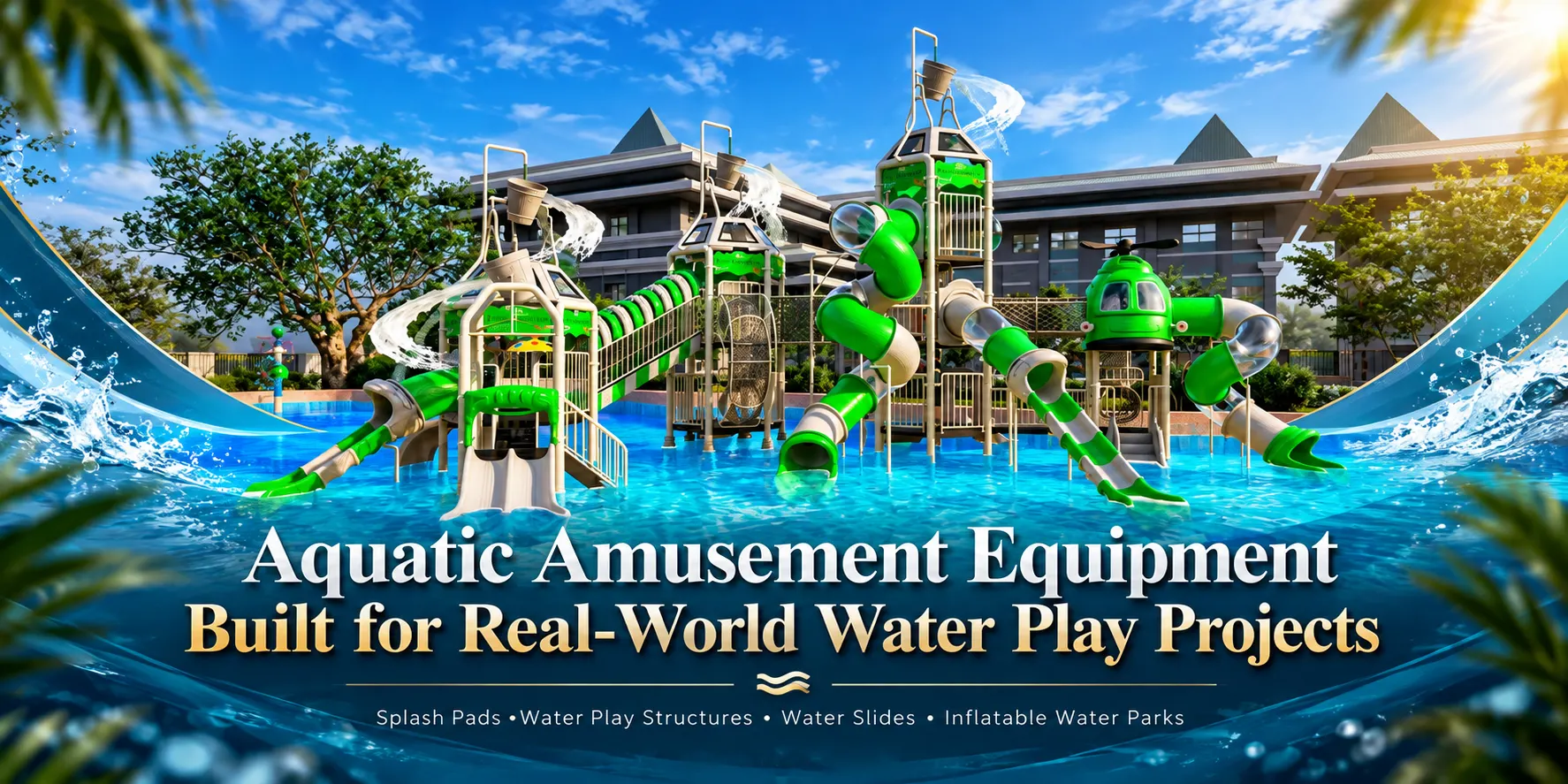
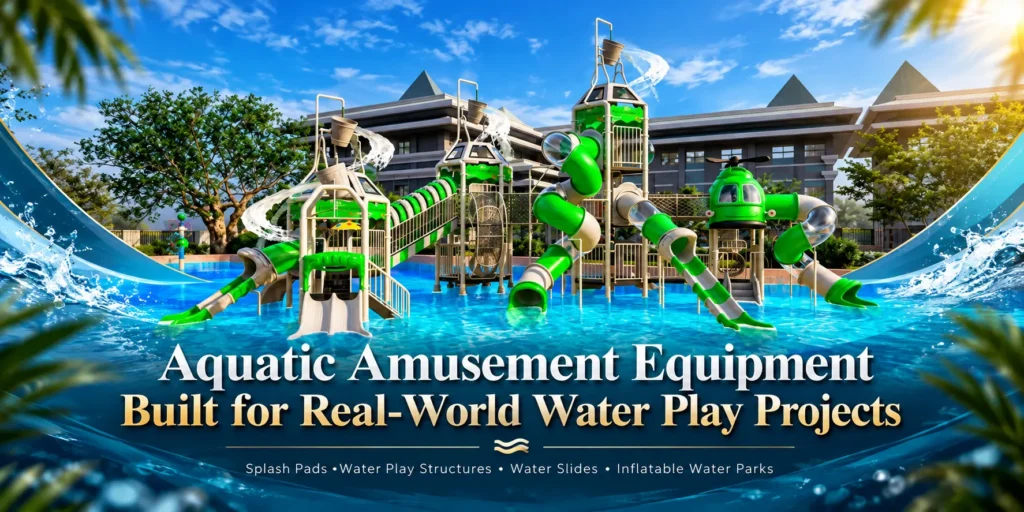
Municipalities, resorts, kindergarten chains, and school project contractors all face the same first problem: comparing equipment families that look nothing alike. A splash pad, a spray park, a water playground, and an inflatable water park solve different site constraints, and each carries its own water supply, footprint, and staffing implications. Before requesting prices, you need a clear view of what you are actually buying.
Aquatic amusement equipment means play structures and water features that circulate, filter, and recirculate water for interactive wet play in public, commercial, and resort settings. The category covers ground sprays, above-ground play units, slides, and inflatable packages.
Supplier catalogs publish these families as separate product lines, so the next section maps each one to the setting it suits.
Catalogs split aquatic amusement equipment into two supply routes: fixed steel-and-concrete play families sold per unit, and inflatable packages quoted as bundles for resorts and events.
- Ground sprays and nozzle arrays — flush deck features for splash pads in parks and school yards.
- Spray cannons — single-point soak features for spray parks and resort poolside zones.
- Dumping and tipping buckets — timed soak moments in water playgrounds for younger children.
- Interactive water play structures — themed towers combining sprays, valves, and paddles.
- Multi-level water playsets — compact vertical wet play for kindergarten and school sites.
- Custom and modular water slides — shallow-run slides for leisure centres, larger flumes for resorts.
- Inflatable pools, water slides, and floating obstacle courses — seasonal resort and event hire.
Commercial catalogs — often from a kids playground equipment manufacturer or school playground manufacturer — list the first six families per unit. Inflatable suppliers cover the seventh as a package. Pump and fixing questions sit behind all seven.
Pump Curves, Filtration, and Fixings Inside Commercial Water Play Systems
The visible play items are the straightforward part of the specification. What decides whether a splash pad runs properly is the pump curve, tank volume, and fixing schedule. A pump sized on nozzle count alone can starve outlets once static head, pipe runs, and site water volume enter the calculation.
Request these on the drawing set:
- Pump curve with flow rate matched to nozzle count
- Filtration unit and collector tank volume
- Recirculation route and water treatment points
- Activation type: sensor, push button, or timed cycle
- Anchoring and fixings for concrete slab or deck mounting
- Drainage falls and surfacing
Supplier catalogues group these as subsystems (filtration systems, collector tanks, interactive features, multi-level playsets, custom slides), so a kindergarten playground manufacturer quotes them alongside the visible structure. Installations stall on three mismatches: pump curves chosen for nozzle count rather than site volume, non-standard fixings, and drawings that omit connection points.
What Should Buyers Expect in an Aquatic Amusement Equipment Quote?
A usable quote reads like a purchasing list, not a brochure. Expect itemised equipment names with quantities, unit price ranges, the shipping basis (FOB, CIF, or delivered), and separate lines for installation, commissioning, staff training, and spare parts. Supplier-published lists usually show ranges rather than fixed figures, so treat every number as an example to confirm against your own drawings. With aquatic amusement equipment, that itemisation is what makes two suppliers comparable at all.
Inflatable water park packages are usually quoted as bundles — pool, slides, blower, repair kit. Splash pad items are quoted per unit: each nozzle, spray cannon, or dumping bucket carries its own line.
| Quote line item | Confirm before ordering |
|---|---|
| Pump and flow rate | Rated flow at your nozzle count |
| Nozzles and spray features | Quantity, pattern, throw height |
| Collector or balance tank | Volume, material, connection sizes |
| Fixings and anchoring | Concrete or deck type, bolt standard |
| Lead time | Production slot, shipping window |
| Installation and commissioning | Days on site, supervision included |
| Spare parts | Nozzle wear parts, seal kits |
With those lines agreed, comparison shifts from price to fit — each buyer type loads a package differently.
Matching Aquatic Amusement Equipment to Municipal Parks, Resorts, School, and Kindergarten Projects
Fit comes down to four variables: space, water supply, season length, and who maintains the kit. Each buyer type weights them differently, so settle the site profile before shortlisting any aquatic amusement equipment.
- Municipal splash pads and spray parks. High public footfall drives water volume and supervision planning. Seasonal staffing favours sensor or push-button activation that runs unattended between attendant shifts.
- Schools and kindergarten chains. Shallow depths — commonly 100–200 mm — low splash impact, compact footprints, and slip-resistant surfacing near classroom buildings.
- Community developers and residential amenity areas. Tight footprints, acoustic limits close to homes, and drainage that must pass to a management company at handover.
- Resorts and event operators. Inflatable packages deploy in hours, then need storage and transport between sites and short seasons.
Budget cycles differ too: councils plan annually, resorts buy for one peak season, kindergartens buy once. With the site profile settled, the next filter is the supplier’s catalog itself.
Supplier Catalog Signals: Product Depth, Drawings, and After-Sales Support
Catalog pages answer the trading-company question quickly. A reseller lists a photo and a product name; a manufacturer shows the same family across sizes, nozzle counts and mounting options. That repeatability matters when you order a second identical set next season.
- Product depth: families shown in multiple configurations, not one stock image.
- Drawings: dimensioned layout plans, nozzle positions and connection points supplied before ordering.
- Customisation: colour, nozzle pattern and structure height adjusted to the site rather than fixed bundles only.
- Spares: nozzles, seals and valve parts listed as separate orderable items.
- Installation: written assembly guidance, or on-site support for complex builds.
- References: installed projects in comparable climates, with notes on water supply and site conditions.
If a supplier answers four of these six, it is worth a shortlist place.
About JQ Playground – kidsplaygroundmanufacturer.com
JQ Playground (Wenzhou Jiqi Amusement Equipment Co., Ltd.) is a children’s playground equipment manufacturer founded in 1993. The company provides design, customization, large-scale manufacturing, sales, installation guidance, and after-sales support for outdoor playgrounds, indoor playgrounds, soft play, water playgrounds, PE board playgrounds, kindergarten furniture, outdoor fitness equipment, pet playgrounds, and playground facilities. Approved company facts include 180+ employees, a large Wenzhou production base, 20+ production lines, 55 production machines, ISO/BSCI/EN1176/EN71/ASTM/CPC/CPSIC certification references, 100+ patents, free design support, OEM/ODM capability, trial installation before shipping, export experience, and one-year quality warranty.