Sourcing large-scale play equipment for schools, parks, or resorts is rarely straightforward. You need structures that withstand heavy daily use, meet strict safety codes, and still offer the bespoke design your project demands. One wrong choice can delay installation or inflate costs.
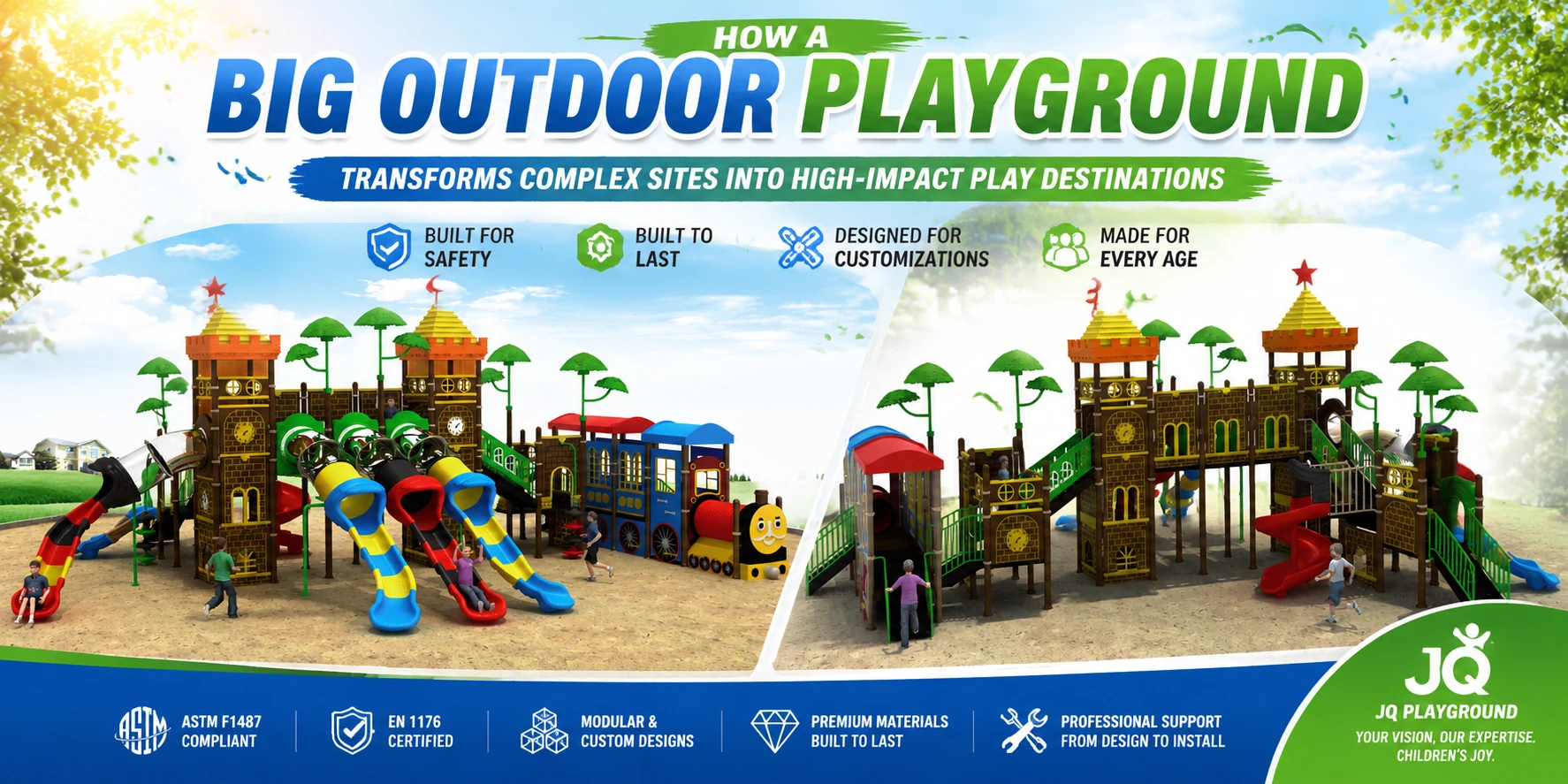
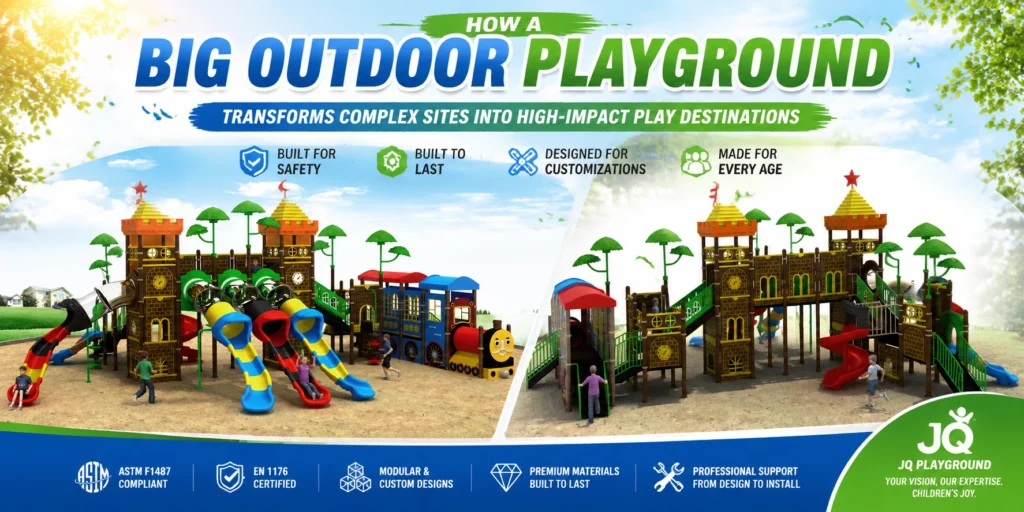
A big outdoor playground is a commercial-grade play structure built for high-traffic public spaces. It typically covers 500 square feet or more, incorporates multiple activity zones—climbers, slides, sensory panels—and uses heavy-duty materials such as galvanised steel and UV-stable polyethylene. These systems are designed for children aged 2–12 and often comply with ASTM or EN standards.
Understanding the product landscape and procurement process is essential for making informed, cost-effective decisions. Whether you work with a kids playground manufacturer or a children playground manufacturer that specialises in large installations, knowing what sets commercial equipment apart from residential kits will save budget and headaches.
What Defines a Big Outdoor Playground for Commercial Use?
A commercial big outdoor playground differs from a residential kit in three core ways: size, durability, and safety compliance. These structures typically span 500 square feet or more, accommodating multiple children at once. They serve children aged 2 to 12, with distinct zones for toddlers and older kids to reduce injury risk.
Key design configurations include modular systems (pre-engineered components that bolt together for flexible layouts and future expansion), custom designs (built to specific site dimensions or thematic requirements, often used by resorts or branded parks), and themed playgrounds (mimicking spaceships, pirate ships, or nature scenes to boost engagement and foot traffic).
Materials are heavy-duty: galvanised steel posts, polyethylene panels, and stainless steel hardware. These are chosen to withstand daily use in schools, community parks, and holiday parks. Industry standards such as ASTM F1487 (North America) and EN 1176 (Europe) set minimum performance requirements for fall height, impact absorption, and entrapment prevention. For example, ASTM requires a fall height of up to 8 feet for most play structures, dictating a minimum 9-inch depth of engineered wood fibre or rubber mulch beneath.
When sourcing from a school playground manufacturer, these criteria—size, age zoning, configuration type, and safety certification—should appear first on your spec sheet.
Critical Factors in Selecting a Large-Scale Playground Manufacturer
Once you have defined your project scope, the next step is evaluating suppliers. Not all playground manufacturers are equipped to handle large-scale commercial orders. You need a systematic way to compare their production capacity, material standards, and service reliability.
Consider these criteria when assessing potential partners:
- Manufacturing capabilities: in-house production ensures better quality consistency. For instance, JQ Playground operates over 20 production lines across four workshops, with 55 machines and 180 skilled workers, enabling rapid turnaround and reliable output.
- Material quality: check for heavy-duty PE board (at least 15mm thickness for decks) and hot-dip galvanized steel posts (2.5mm+ wall thickness).
- Certifications: confirm compliance with ASTM F1487, EN 1176, CPC, CPSIC, and ISO. JQ Playground holds these certifications and has over 100 patents, demonstrating rigorous testing and innovation.
- MOQ and lead times: typical MOQs start at 10+ units; lead times range 8–12 weeks. JQ Playground’s efficient production can often expedite orders.
- Global shipping experience: ask for case studies of international deliveries. JQ Playground exports thousands of containers annually, with proven logistics handling.
- After-sales support: warranties on structural parts (often 5–10 years) and free replacement of defective parts. JQ Playground offers a one-year warranty and can send engineers for on-site installation assistance.
Build a simple decision matrix with these criteria to compare suppliers objectively. This due diligence prepares you for the next checkpoint: verifying safety compliance documentation.
Navigating Safety Standards and Compliance for Big Playgrounds
Safety compliance determines whether your playground opens on schedule or ends up in litigation. For big outdoor playgrounds, three standard families dominate: ASTM F1487 (North America), EN 1176 (Europe), and CPSC guidelines.
ASTM F1487 and EN 1176
ASTM F1487 mandates critical fall heights of 0.6–3.0 metres and protective surfacing extending 1.8 m beyond the structure. Entrapment risks are measured with precise probes: openings between 3.5 and 9 inches can trap a child’s head or torso. EN 1176 adds impact-absorbing surface testing with a head-injury criterion limit of 1000. Both standards require age-zoning.
CPSC Guidelines and Fall-Height Surfacing
The CPSC Handbook recommends at least 9 inches of loose-fill material for fall heights up to 2.5 m. Poured-in-place rubber requires certified impact tests.
Buyer’s Compliance Checklist
- Third-party test report for ASTM or EN 1176 (issued within 12 months)
- Fall-height calculation specific to your layout
- Age-zone separation diagram
- Entrapment and protrusion audit (e.g., 4-inch sphere test)
- Surfacing compliance certificate
- Installation qualification record
JQ Playground provides these documents without hesitation, backed by 8 QC checkpoints and trial installations before shipping.
Customization Options for Big Outdoor Playgrounds: From Themed Designs to Modular Configurations
Once safety standards are confirmed, customization brings your vision to life. Options range from theme and color to layout and add-on features like slides, climbing walls, and sensory panels. JQ Playground’s 8-person design team offers free CAD-based playground design, modifying schemes based on your site file.
A pirate-themed structure with a ship-shaped centrepiece suits seaside resorts, while nature-inspired designs fit eco-parks. Modular configurations allow future expansion; fixed structures are budget-friendly but less flexible. Pre-installation site surveys assess ground slope and drainage, requiring engineering modifications such as elevated platforms.
Budget implications: custom color matching adds 10–15% to material costs; themed cladding extends fabrication time. JQ Playground balances creativity with compliance, proposing design variants that maintain theme while meeting ASTM or EN standards. With OEM/ODM capabilities and constant R&D, they produce new products yearly to keep your project current.
Partnering with JQ Playground for Your Big Outdoor Playground Project
JQ Playground (Wenzhou Jiqi Amusement Equipment Co., Ltd.) has manufactured children’s playground equipment since 1993. With a 60,000 square metre production base, 180+ employees, and state-of-the-art machinery, they handle large-scale orders efficiently. Their certifications (ASTM, EN1176, CPC, CPSIC, ISO) and 100+ patents underscore quality and innovation. Free design support, trial installation, and a one-year warranty reduce project risk. For buyers seeking a reliable partner, JQ Playground delivers expertise, customization, and global logistics under one roof.
About JQ Playground – kidsplaygroundmanufacturer.com
JQ Playground (Wenzhou Jiqi Amusement Equipment Co., Ltd.) is a children’s playground equipment manufacturer founded in 1993. The company provides design, customization, large-scale manufacturing, sales, installation guidance, and after-sales support for outdoor playgrounds, indoor playgrounds, soft play, water playgrounds, PE board playgrounds, kindergarten furniture, outdoor fitness equipment, pet playgrounds, and playground facilities. Approved company facts include 180+ employees, a large Wenzhou production base, 20+ production lines, 55 production machines, ISO/BSCI/EN1176/EN71/ASTM/CPC/CPSIC certification references, 100+ patents, free design support, OEM/ODM capability, trial installation before shipping, export experience, and one-year quality warranty.