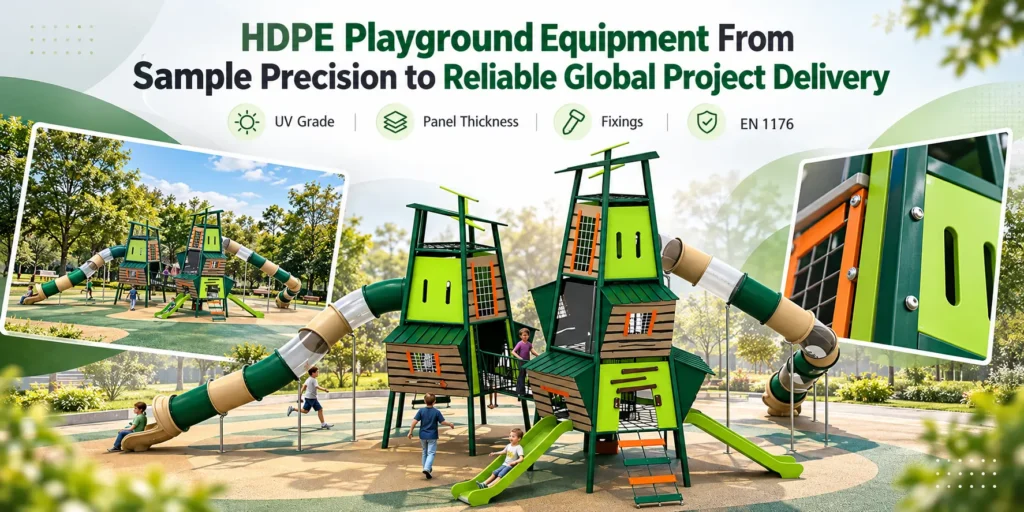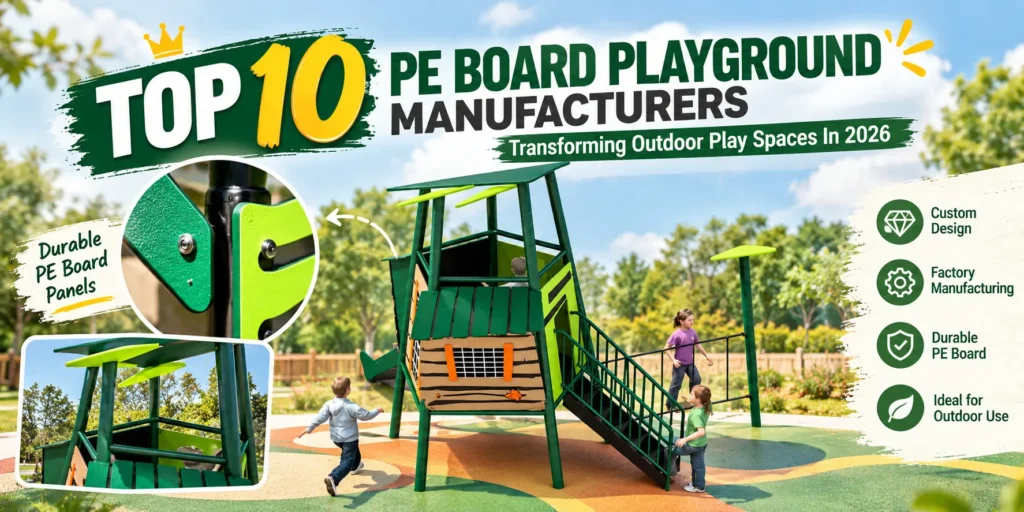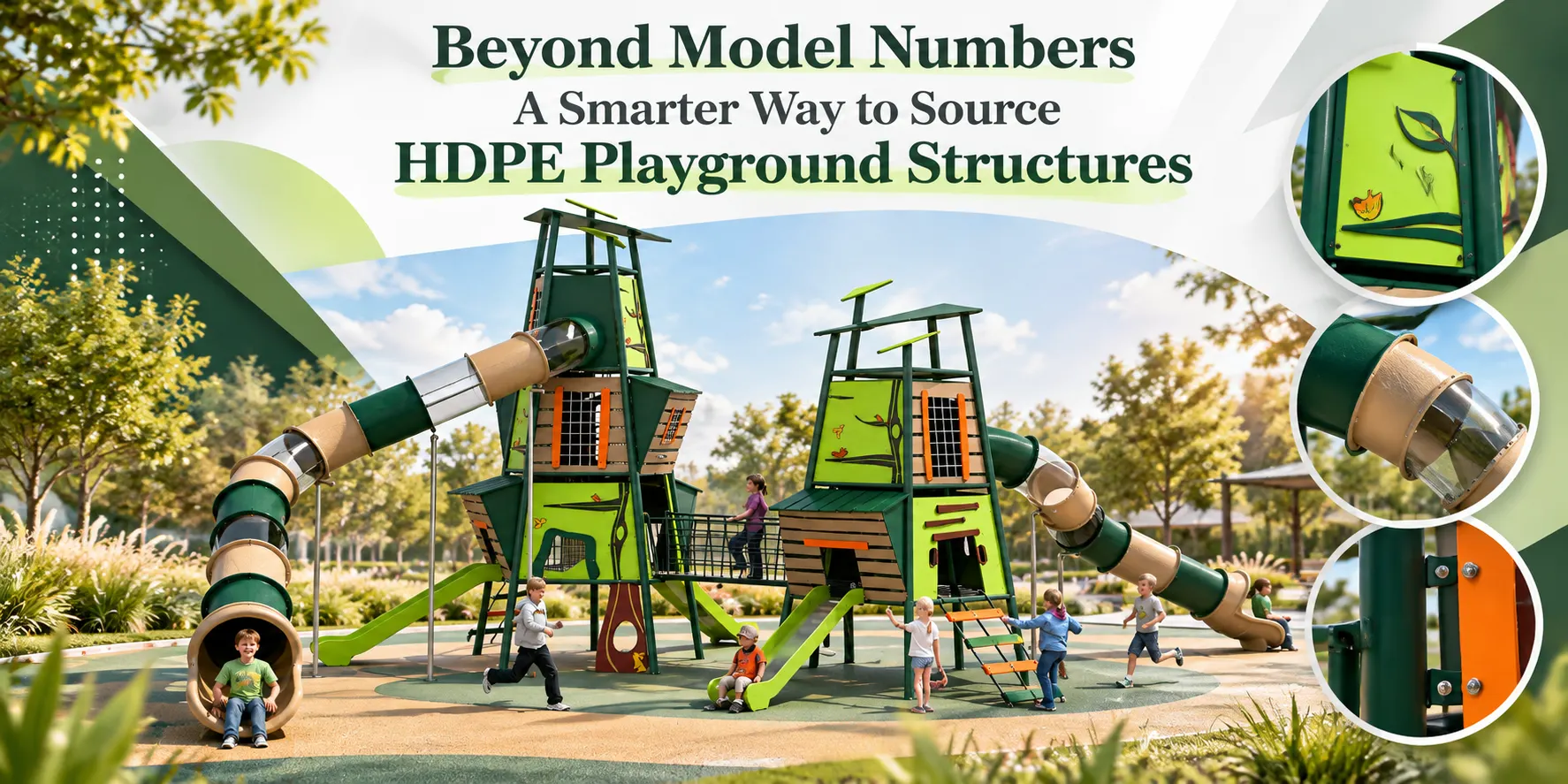
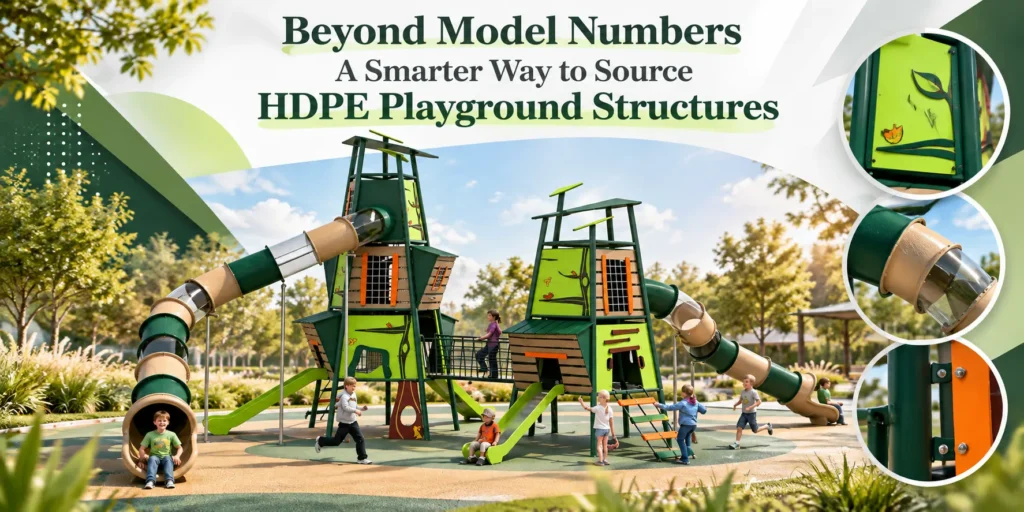
Comparing quotes for a school, kindergarten or community play area is harder when every supplier lists hdpe playground structures under different material and model labels. You need like-for-like data on footprint, age zone, panel format and finish before you can judge value. HDPE playground structures are outdoor play systems made mainly from high-density polyethylene components — moulded panels, posts, decks and slides — used where moisture, splintering and colour retention matter. This short buyer’s guide covers model formats, HDPE versus DHPE labels and the specification details to request from a children playground manufacturer.
HDPE Playground Structures: Model Formats, Footprints, and Price Benchmarks
Supplier catalogues label these systems three ways: a model code (HP-4102), a series name, or a format label such as “compact tower” or “multi-deck”. The format label tells you more than the code does. Footprints below are platform-only; add a fall-zone margin of roughly 1.5–2 m on each open side when marking out ground.
| Format | Footprint (cm) | Footprint (ft) | Age zone | Indicative FOB band per set |
|---|---|---|---|---|
| Compact tower | 180 × 180 | 5.9 × 5.9 | 2–5 | US$400–900 |
| Slide-and-climb module | 300 × 240 | 9.8 × 7.9 | 2–5 or 5–12 | US$900–2,000 |
| Multi-deck combination | 420 × 300 | 13.8 × 9.8 | 5–12 | US$2,500–6,000 |
| Panel system (per panel) | 120 × 120 | 3.9 × 3.9 | 2–5 | US$150–400 |
Configuration sits on top of the base format: deck height, slide type (straight, spiral, double), panel infill and colour. These bands are benchline signals only — a 2–5 tower and a 5–12 multi-deck rarely share a band, and a second slide can shift a quote by 20–30%. Any school playground manufacturer should confirm against your dimensioned drawing.
With format settled, material labels decide the rest.
HDPE vs. DHPE vs. Recycled Plastic Play Structures: Material Labels Buyers Will See
The labels are not interchangeable grades. HDPE is the base resin; DHPE is used inconsistently, so confirm whether it means double-wall, dual-layer, or a supplier term; recycled plastic describes feedstock, often recycled HDPE or mixed plastic lumber. For hdpe playground structures, check the datasheet before comparing price.
| Label | Verify | Play-structure fit |
|---|---|---|
| HDPE | UV stabiliser, 10–18 mm panel, colourfastness | Bright colour, no splinters, easy panel swap |
| DHPE | Double-wall or dual-layer, wall thickness, colour layer | Stiffer feel, hidden fixings; compare single vs 2-layer |
| Recycled | Recycled content %, feedstock, UV package, batch shade | Matte finish; batch-to-batch colour variation |
All three resist rot and corrosion; none should splinter like timber. UV performance depends on additives, not the label. Ask for wet-dry and -20°C to 60°C data and a same-batch spare panel. Repairability favours bolt-on HDPE panels over bonded recycled sections. With the label pinned down, modular age zoning is easier to specify.
Modular HDPE Play Structures for Age-Zoned Spaces
Start with the zone split. Peer modular categories sell base towers plus add-on kits, so plan a 2–5 bay and a separate 5–12 bay rather than one tall unit. For a 12 × 8 m kindergarten plot, place a 120 cm deck tower for 5–12 at the centre, ring it with 60 cm-high 2–5 panels, and leave a 1.5 m sightline gap. Use 120 × 120 cm module bays to keep expansion simple. Specify clamp-free bolted HDPE panels with captive nuts. Add a 3 × 3 m shade sail over the 2–5 zone. Order one spare panel per colour. An OEM kids playground manufacturer can pre-drill expansion kits for a later 120 cm bay.
What HDPE Playground Structure Suppliers Expose for RFQ and Customization
Those pre-drilled expansion kits only save time when the supplier’s RFQ data matches your bay layout. Product pages that list model codes, deck heights in cm, footprint dimensions, and panel counts cut the clarification loop. Use this checklist:
- Customisation scope: RAL colour codes, panel infill options, module combinations (a 120 cm tower beside a 60 cm panel run), and logo areas.
- Order volume: batch sizes per colour, production slots per month, and spare-panel allowance as a percentage.
- Packaging and export: flat-pack panel counts per crate, corner protection, container loading plan, FOB port, and document set.
- Contact signals: named technical contact, drawing revision dates, and response time for a dimension change.
- Specification sheets: panel thickness in mm, hardware type (stainless steel bolts), deck panel span, and fixing centres.
A kids outdoor playground manufacturer that publishes these fields shortens your RFQ. A kids indoor playground manufacturer should match the same detail for panel systems. Missing fields turn a modular plan into a chain of emails.
About JQ Playground – kidsplaygroundmanufacturer.com
JQ Playground (Wenzhou Jiqi Amusement Equipment Co., Ltd.) is a children’s playground equipment manufacturer founded in 1993. The company provides design, customization, large-scale manufacturing, sales, installation guidance, and after-sales support for outdoor playgrounds, indoor playgrounds, soft play, water playgrounds, PE board playgrounds, kindergarten furniture, outdoor fitness equipment, pet playgrounds, and playground facilities. Approved company facts include 180+ employees, a large Wenzhou production base, 20+ production lines, 55 production machines, ISO/BSCI/EN1176/EN71/ASTM/CPC/CPSIC certification references, 100+ patents, free design support, OEM/ODM capability, trial installation before shipping, export experience, and one-year quality warranty.