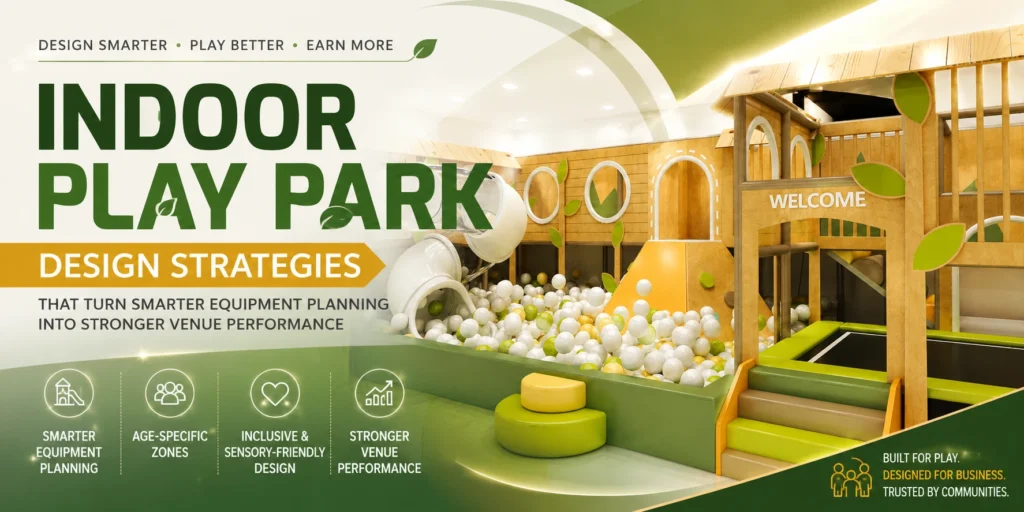
Indoor play parks are opening at a record pace across the UK, driven by family demand for year-round, weather-proof play. Yet manufacturers, distributors, and contractors often design equipment without studying how these venues actually operate. That oversight leads to poor layouts, underused zones, and costly retrofits.
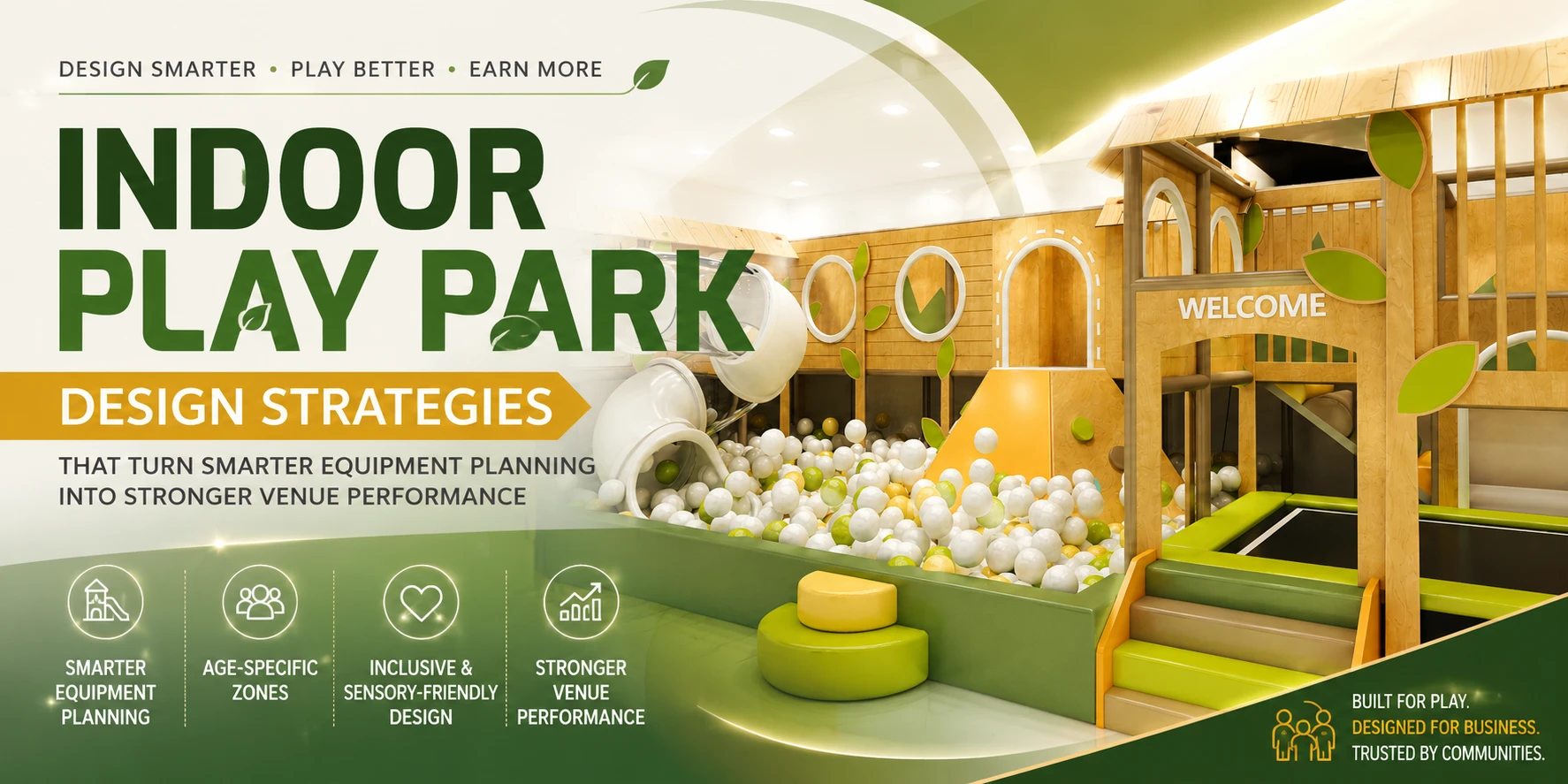
An indoor play park is an indoor recreational facility with playground structures such as climbing frames, slides, ball pits, and soft play areas, often combined with party rooms and food service.
The sections ahead cover the market insights and equipment planning guidance that prevent those mistakes.
Equipment Trends Across Leading Indoor Play Park Venues
The attraction mix shown on leading venue sites is strikingly consistent. A review of Complete Playground, Flying Apple, The Kids Town and Land O Fun surfaces the same core categories:
- Multi-level climbing structures and interconnected towers
- Slides at varying heights, including tunnel slides
- Ball pits and foam-based soft play areas
- Toddler-specific zones with low-level obstacles
- Sensory-friendly corners with tactile panels and quiet seating
- Themed party rooms built into the floor plan
Flying Apple’s open-play layout lets children move freely between climbing, sliding and ball-play zones. The Kids Town promotes its indoor play space as clearly separated, age-appropriate equipment within one footprint. The message for a kids playground equipment manufacturer is direct: modular structures with custom theming outperform fixed, one-size designs. Operators want floor-plan adaptability, so equipment that reconfigures around party rooms, café seating and accessible routes reduces install time and lifts daily utilisation. Those same layout choices later influence how venues price parties and admission — the revenue picture covered next.
Admission Fees, Memberships, and Party Packages as Revenue Blueprints
How much does an indoor playground cost? Most venues charge £6–£14 per child for daily admission, with off-peak discounts and sibling rates. Memberships typically run £30–£60 monthly, and party packages price from £150 to £400 depending on guest numbers.
Common pricing tiers:
– Day passes: single-visit tickets with session time limits
– Multi-visit cards: 5 or 10 entries to smooth cash flow
– Monthly or annual memberships: predictable recurring income
– Party packages: room hire, food and reserved play at premium rates
Each tier changes equipment buying. Day passes demand durable, low-maintenance structures built for constant use. Memberships reward variety, so modular layouts that rotate or expand keep repeat visitors engaged. Party packages create high-traffic peaks, so zones must absorb concentrated groups without queues. A custom kids playground manufacturer can use these payback scenarios to justify stronger materials and configurable designs against upfront cost.
Inclusive Design and Sensory-Friendly Equipment as a Community Standard
Sensory-friendly provision is no longer optional; it is a baseline expectation. Complete Playground runs neurodivergent-friendly hours and promotes accessible play for all ages, showing how inclusion drives repeat visits. For an OEM kids playground manufacturer, this standard demands more than physical safety.
Design considerations:
- Quiet zones — recessed, low-stimulation corners with soft seating and reduced visual clutter.
- Tactile panels — wall-mounted textures, gears and light-up elements for hands-on exploration.
- Wheelchair-accessible platforms — ramps and wide transfers connecting upper levels, not just ground-floor play.
- Noise-dampening materials — acoustic ceiling tiles and foam cladding that lower overall sound pressure.
- Soft lighting — dimmable, warm LED options that avoid harsh glare.
Floor plans must route accessible paths through the entire venue, not around it. An ODM kids playground manufacturer can deliver these features as standard modules, letting operators differentiate without bespoke design delays. Inclusive play builds trust, and trust builds return visits.
Age-Specific Play Zones From Toddlers to Tweens: Equipment Planning by Developmental Stage
Venues on the SERP split their floors by age, not just by theme. The Kids Town takes babies to 7 years, Happy Bees stops at 3, and Flying Apple spans 1 to 10. Those ranges set the real design brief: equipment must scale with motor skills, confidence, and physical size.
| Venue | Age range | Typical equipment |
|---|---|---|
| Happy Bees | 8 months to 3 years | Soft play blocks, sensory panels, shallow ball pits |
| The Kids Town | Babies to 7 years | Small slides, toddler climbing frames, ball pits |
| Flying Apple | 1 to 10 years | Multi-level structures, rope bridges, obstacle courses |
Modular equipment is the practical answer. A kids indoor playground manufacturer can build one frame family with interchangeable slides, platform heights, and balustrades, so the same core parts form a toddler corner and a tween obstacle course. For distributors and contractors, that means fewer SKUs to stock, faster installation, and a floor plan you can adjust when an operator shifts their age mix. Sell the age-segmented layout as a cost argument: one modular system, several revenue zones.
About JQ Playground – kidsplaygroundmanufacturer.com
JQ Playground (Wenzhou Jiqi Amusement Equipment Co., Ltd.) is a children’s playground equipment manufacturer founded in 1993. The company provides design, customization, large-scale manufacturing, sales, installation guidance, and after-sales support for outdoor playgrounds, indoor playgrounds, soft play, water playgrounds, PE board playgrounds, kindergarten furniture, outdoor fitness equipment, pet playgrounds, and playground facilities. Approved company facts include 180+ employees, a large Wenzhou production base, 20+ production lines, 55 production machines, ISO/BSCI/EN1176/EN71/ASTM/CPC/CPSIC certification references, 100+ patents, free design support, OEM/ODM capability, trial installation before shipping, export experience, and one-year quality warranty.