Selecting equipment for a commercial playground project is rarely straightforward. You must evaluate safety standards, material durability, age-group suitability, and long-term maintenance costs within a single procurement cycle. Each decision affects both budget and user experience.
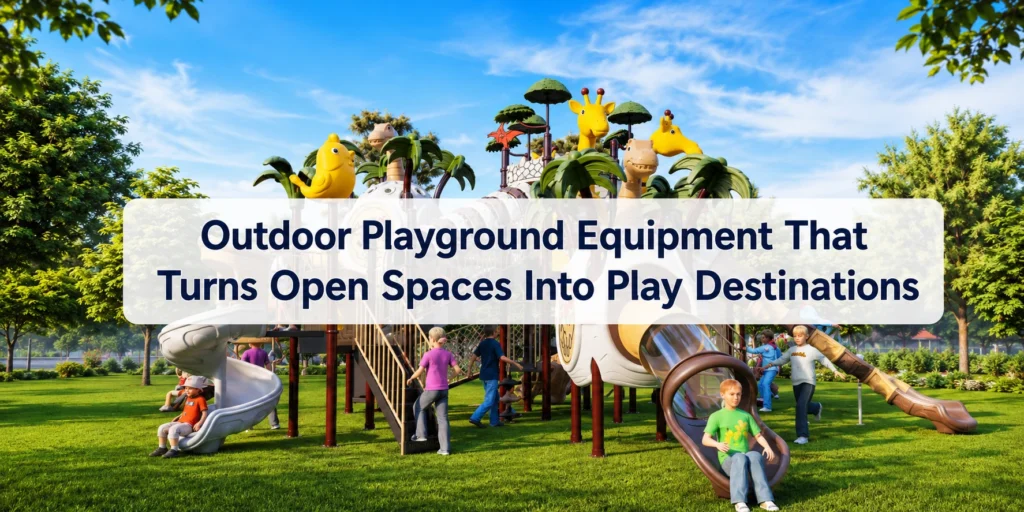
Outdoor playground equipment refers to structures designed for children’s play in public spaces, schools, parks, and community areas. The category includes swings, slides, climbers, merry-go-rounds, and multi-play units built to withstand heavy daily use across all weather conditions.
This guide examines the major equipment types available, the safety certifications required for commercial installations, how customisation and OEM services work for branded projects, and the practical procurement factors—such as minimum order quantities and lead times—that buyers need to consider when evaluating a kids playground manufacturer or children playground manufacturer.
Types of Outdoor Playground Equipment for Commercial Projects
Commercial playgrounds need a balanced selection of activity types to serve different age groups and developmental goals. The seven core categories each address specific physical, social, and cognitive needs.
- Swings are essential for school playgrounds and park installations. Bucket seats suit toddlers (18 months–4 years), while belt seats work for older children. Inclusive options include flat-platform swings with full harness supports and cradle seats.
- Slides come in straight, wave, tube, and spiral formats. Straight slides fit compact sites, whereas tube slides add enclosed height for children aged 5–12 years. Fall-zone clearance must match the slide height per EN 1176 standards.
- Climbers include A-frames, arch climbers, dome structures, and rope nets. These build upper-body strength and spatial reasoning. A reputable kids playground equipment manufacturer will offer graduated difficulty levels so the same structure challenges both beginners and confident climbers.
- Merry-go-rounds develop balance and coordination through spinning motion. Modern commercial models feature ground-level access, contoured handgrips, and centrifugal speed controls for safer rotation.
- Spring riders are single-user rockers mounted on heavy-duty steel coils. They suit children aged 2–5 years and are common in community centre playgrounds and early-years settings.
- Play panels deliver ground-level cognitive engagement through mazes, tic-tac-toe, steering wheels, and gear boards. They are often integrated into composite play structures and support inclusive play by remaining accessible to children using mobility aids.
Age-group zoning is non-negotiable for commercial projects. Separate areas for toddlers (under 3 years), preschoolers (3–6 years), and school-age children (6–12 years) reduce injury risk and ensure age-appropriate challenge. Inclusive design should include transfer platforms, wide ramps, and sensory panels so children of all abilities play together rather than in segregated zones.
Key Safety Certifications and Standards for Outdoor Playground Equipment
If your playground equipment lacks the correct certification for its target region, the project may fail inspection — or worse, expose you to liability claims. Four global standards govern commercial playground safety, and your supplier must comply with the one that applies to your market.
| Region | Standard | Key Compliance Criteria |
|---|---|---|
| United States | ASTM F1487 | Impact attenuation (critical fall height up to 3m), entrapment prevention, structural integrity, accessible routes per ADA |
| Europe | EN 1176 | Fall height zones, impact-absorbing surfacing, clearance spaces, entanglement hazards, age-group separation |
| Canada | CSA Z614 | Similar to ASTM with added cold-climate material requirements, slip resistance, and Canadian accessibility codes |
| Australia & New Zealand | AS 4685 | Based on EN 1176 with modifications for UV stability, local climate, and Australian accessibility standards |
Verifying that your supplier’s equipment meets the relevant standard reduces your liability risk and speeds up project approval. Ask for third-party test reports — not just a supplier declaration — before placing any order. A custom kids playground manufacturer should provide compliance documentation as part of the procurement package. For instance, JQ Playground, a children’s playground equipment manufacturer founded in 1993, holds EN1176, ASTM, BSCI, and CPC certifications, ensuring that their equipment meets global safety requirements.
Customization and OEM Services for Outdoor Playground Equipment
Beyond compliance, the real value of a partner lies in how far they can tailor the product to your project brief. Customisation options range from simple colour swaps to entirely bespoke structures. You can specify brand colours, logos on play panels, and signage that turns a public playground into a marketing asset for a housing development or a themed attraction for a resort.
OEM and ODM services give distributors and contractors a clear edge. An OEM kids playground manufacturer can replicate your brand identity across multiple sites, creating a consistent look that strengthens recognition. An ODM kids playground manufacturer, by contrast, helps you design from scratch – critical when site dimensions, fall zones, or ground contours rule out standard models. Tailored layouts also reduce wasted space and allow for multi-purpose structures that combine climbing, sliding, and social play in one footprint.
JQ Playground offers a comprehensive OEM/ODM service with a dedicated 8-person design team that provides free CAD-based playground design. Their custom manufacturing capabilities cover a wide range of materials—including HDPE, powder-coated steel, and timber—and they can produce any colour in the RAL range. With over 100 patents and constant R&D, JQ Playground delivers innovative, tailored solutions for commercial projects.
Inclusive design is increasingly non-negotiable. Custom builds can integrate ramps, transfer platforms, and ground-level activities compliant with ADA or EN17210 standards. Theme-based playgrounds – a pirate ship, a castle, a jungle trail – are popular examples where custom fabrication creates a unique draw. Using HDPE or powder-coated steel, manufacturers can produce any colour in the RAL range, so your equipment matches the surrounding landscape or interior decoration of an indoor centre.
Procurement Factors: MOQ, Pricing, and Delivery for Outdoor Playground Equipment
Procurement for commercial playground equipment centres on three variables: minimum order quantity (MOQ), per-unit pricing, and delivery logistics. These factors shift with material choice and design complexity. Understanding them upfront prevents budget overruns and project delays.
- MOQ ranges. Standard modular designs (swings, simple slides) often have MOQs of 1–3 sets. Custom or themed equipment usually requires a minimum of 5–10 units, because tooling and moulds are project-specific. Confirm MOQ before requesting a quote. JQ Playground offers flexible MOQs, accommodating both small and large projects.
- Pricing by material and complexity. Basic HDPE play structures start around £2,000 per unit. Metal-framed equipment with powder-coated finishes typically costs £5,000–£15,000. Large timber playgrounds with bespoke features can exceed £30,000. Complexity—moving parts, multi-level platforms, inclusive elements—adds 20–40% to the baseline price.
- Lead times are 4–8 weeks for standard designs. Custom projects with new moulds or specialised colours stretch to 10–12 weeks. Seasonal peaks (spring/summer) can add 2–3 weeks, so plan procurement 3–4 months ahead. JQ Playground’s efficient production lines—with 20+ production lines and 55 machines—enable delivery of a 40HQ container within 3 days when a production line is dedicated.
- Shipping considerations. Most outdoor playground equipment ships in 20ft or 40ft containers. A typical slide-and-swings combo fits a 20ft container; larger multi-activity structures require a 40ft high-cube. Freight cost from Asian manufacturers to Europe ranges £2,500–£6,000 per container, depending on port and volume. Disassembling equipment for flat-pack shipping reduces container count. JQ Playground exports over 2,000 containers per year and offers trial installation before shipping to ensure quality.
When evaluating a supplier, request material samples (HDPE colour swatches, powder-coat chips) to verify colour and durability. Ask for reference projects with photos and site photos—any reputable kids outdoor playground manufacturer will share at least three past installations. This step alone confirms fabrication quality and real-world performance. JQ Playground provides free design support, a one-year warranty, and after-sales service including engineer dispatch if needed, making them a reliable partner for B2B projects.
About JQ Playground – kidsplaygroundmanufacturer.com
JQ Playground (Wenzhou Jiqi Amusement Equipment Co., Ltd.) is a children’s playground equipment manufacturer founded in 1993. The company provides design, customization, large-scale manufacturing, sales, installation guidance, and after-sales support for outdoor playgrounds, indoor playgrounds, soft play, water playgrounds, PE board playgrounds, kindergarten furniture, outdoor fitness equipment, pet playgrounds, and playground facilities. Approved company facts include 180+ employees, a large Wenzhou production base, 20+ production lines, 55 production machines, ISO/BSCI/EN1176/EN71/ASTM/CPC/CPSIC certification references, 100+ patents, free design support, OEM/ODM capability, trial installation before shipping, export experience, and one-year quality warranty.