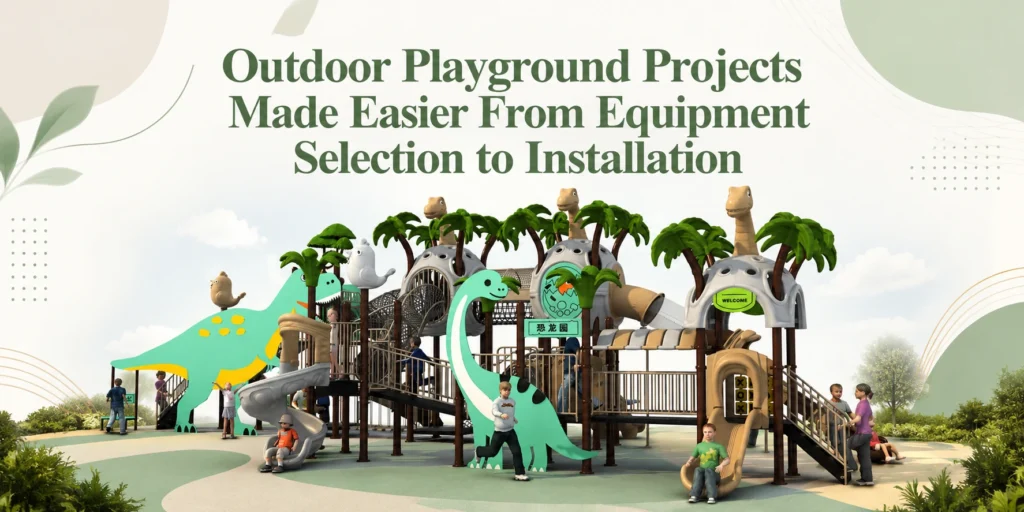
You need outdoor playground equipment that delivers on safety, durability, and project timelines. Every commercial installation — whether for a school, public park, or housing development — must pass compliance checks before children ever touch the play surface. That puts pressure on buyers to select suppliers who understand both manufacturing standards and site requirements.
An outdoor playground is a structured play area using commercial-grade equipment designed for multi‑user, high‑traffic environments. It typically includes swings, slides, climbers, and multi‑play centres. Materials such as galvanised steel and HDPE are standard because they withstand weather and daily wear. European safety standard EN1176 governs many of these designs, specifying fall heights, spacing, and surfacing depths.
This guide covers the main equipment types, sourcing criteria, OEM project workflows, and installation compliance. Whether you are procuring for a single community park or a national school chain, knowing how to evaluate a kids playground manufacturer or select a children playground manufacturer is critical to avoiding delays and cost overruns.
Types of Outdoor Playground Equipment for Commercial Spaces
Commercial outdoor playground equipment breaks down into seven main categories. Each type serves a specific purpose, age group, and installation environment. Understanding these distinctions helps you select the right mix for a school playground, community park, or housing development.
Swings — typically feature galvanised steel frames and moulded rubber or plastic seats. Bucket seats suit toddlers (2–4 years), while flat belt seats work for older children (5–12 years). Schools often specify a minimum swing height of 2.4 m to EN1176 standards. Slides — constructed from rotomoulded polyethylene or stainless steel. Straight slides are common for younger users; spiral or tube slides provide higher challenge for 5–12 year olds. Fall height ranges from 1.0 m to 3.0 m, requiring appropriate safety surfacing. Climbers — net climbers, arch climbers, and rock walls. Materials include powder-coated steel, UV-stable HDPE, and polypropylene rope. Age-appropriate designs: low-profile units for 2–5 year olds, vertical climbing elements for 5–12 year olds. Seesaws and spring riders — fulcrum seesaws use a steel mechanism with HDPE seats; spring riders rely on a single heavy-duty coil spring. Both suit ages 2–6 and are popular in smaller park settings. Multi-play structures — composite units combining slides, tunnels, platforms, and climbing panels. Sized for 2–5 or 5–12 year olds, typically installed in school yards and large community parks. Inclusive equipment — transfer decks, ramps, sensory panels, and ground-level activities that meet ADA and EN1176 accessibility clauses. A growing requirement for public playgrounds, often specified by councils.
When selecting a kids playground equipment manufacturer for a school project, confirm that each component carries EN1176 (Europe) or ASTM F1487 (North America) certification. For community parks, a mix of multi-play structures and inclusive equipment tends to balance budget and inclusivity.
The next section covers the practical sourcing checklist — from certification verification to lead-time management.
Key Considerations When Sourcing Outdoor Playground Equipment
Start your sourcing process by verifying three non-negotiable elements: safety certification, material construction, and manufacturer lead time. The checklist below covers the critical checkpoints commercial buyers routinely overlook.
- Safety certifications. Every piece must comply with ASTM F1487 (US) or EN1176 (Europe). Ask for current test reports, not just a logo on a brochure. Without these, installation sign-off and insurance coverage are at risk.
- Material quality. Specify galvanized steel for structural frames (hot-dip, minimum 2 mm wall thickness). HDPE panels should be UV-stabilised to prevent fading within two seasons. Rotomolded plastic components must show uniform wall thickness — thin spots indicate poor moulding.
- Customisation options. Many buyers need custom colours, slide lengths, or themed panels for their project. A supplier that offers custom moulds or laser-cut HDPE shapes can match your design brief, but expect higher MOQs and 2–4 extra weeks in production.
- MOQ and warranty. Minimum order quantities vary widely. Some manufacturers demand 10 units per model; others accept 3–5 for mixed orders. Look for a 10-year warranty on structural steel and 5 years on plastics — otherwise replacement costs will hit your budget within three years.
- Export logistics and lead times. Confirm whether the supplier handles FOB or CIF shipping. Lead times for standard equipment range from 15–30 working days; custom orders can stretch to 50 days. Factor in customs clearance time at the destination port.
One common pitfall is insufficient anchoring — wind uplift on heavy steel frames is underestimated. Specify ground anchors rated for your local wind zone. Another is UV degradation: non-stabilised plastics crack within 18 months of direct sun exposure. Insist on UV8‑grade HDPE or UV‑stabilised rotomoulded PE.
This checklist narrows your field to suppliers who can deliver compliant, durable equipment on schedule. The next step is evaluating their engineering and project management capabilities for custom builds.
How to Evaluate Manufacturers for Custom and OEM Projects
Once you have a shortlist of compliant suppliers, the real evaluation begins. You need to verify that the manufacturer can engineer your specific design and manage the project from concept to delivery.
Start by requesting portfolios that show completed OEM kids playground manufacturer projects. Look for evidence of similar scale, material quality, and safety compliance. Ask for certifications such as EN1176 or ASTM F1487. A factory visit, though not always possible, provides the clearest picture of their production capacity and quality control.
Design Services and the Sample Process
Some manufacturers offer in-house design teams that create bespoke play structures from your brief. Others modify existing models to fit your specifications. The first approach gives you full customisation; the second can reduce lead times and costs. Always request CAD drawings before approving a design. Ask for a sample unit to verify material thickness, UV stability of HDPE, and joint strength before committing to a full production run.
Communication, Compliance, and References
Custom projects demand clear, ongoing communication. Confirm who your project manager will be and how they handle design changes. Request compliance documentation for every component, including load testing reports for climbers and swing beams. Ask for client references from similar school or park installations. A quick call with a past buyer can reveal responsiveness and on-time delivery performance.
These evaluation steps cut the risk of costly delays or safety failures. Once you select a partner, move to the installation and compliance checklist to ensure the build meets site requirements.
Why Choose an Experienced Manufacturer like JQ Playground
When evaluating manufacturers, consider one with decades of expertise and a proven track record in outdoor playground production. JQ Playground (the international trade brand of Wenzhou Jiqi Amusement Equipment Co., Ltd.) has been in the industry since 1993, operating a 60,000 m² production base in Wenzhou, China. The company employs over 180 skilled workers and runs 20+ production lines with 55 machines, enabling it to deliver a 40HQ container within three days per line. JQ Playground holds certifications including EN1176, ASTM F1487, and ISO, and holds over 100 patents for its designs. It offers free CAD-based playground design through an 8-person design team, OEM/ODM services, trial installation before shipping, and a one-year quality warranty with replacement of defective parts. With exports of over 2,000 containers annually, JQ Playground serves clients worldwide, making it a reliable partner for school, park, and community playground projects.
Installation and Compliance Checklist for Contractors and Developers
Start with a level, well-drained site. Grade the area to a maximum 1° slope and ensure runoff is directed away from play equipment — a 2% gradient works for most permeable surfaces. The most frequent mistake on site is incorrect surfacing depth. Match the depth of loose-fill material (wood chips, rubber mulch, sand) to the critical fall height of the tallest structure. A 2.4 m platform requires at least 300 mm of compacted depth per EN 1176 and ASTM F1292. Less than that and impact attenuation fails.
Assembly and anchoring
- Torque all bolted connections to the manufacturer’s specification, typically 20–40 Nm. Re-torque after the first 48 hours of use.
- Concrete footings must cure for 28 days before equipment is mounted. Anchors must withstand a 450 N lateral pull test.
Inspection and documentation
- Measure every opening between 89 mm and 230 mm — those gaps cause head entrapment.
- Mark the fall zone as a minimum 1.8 m radius from each structure’s perimeter.
- Keep as-built drawings, torque logs, and surfacing test reports. A kids outdoor playground manufacturer often supplies installation drawings and torque data to simplify this step.
Timeline estimate
For a small playground (2–5 pieces), allow 2–4 weeks from site preparation through final sign-off. Delays typically come from incorrect surfacing depth or incomplete concrete curing.
About JQ Playground – kidsplaygroundmanufacturer.com
JQ Playground (Wenzhou Jiqi Amusement Equipment Co., Ltd.) is a children’s playground equipment manufacturer founded in 1993. The company provides design, customization, large-scale manufacturing, sales, installation guidance, and after-sales support for outdoor playgrounds, indoor playgrounds, soft play, water playgrounds, PE board playgrounds, kindergarten furniture, outdoor fitness equipment, pet playgrounds, and playground facilities. Approved company facts include 180+ employees, a large Wenzhou production base, 20+ production lines, 55 production machines, ISO/BSCI/EN1176/EN71/ASTM/CPC/CPSIC certification references, 100+ patents, free design support, OEM/ODM capability, trial installation before shipping, export experience, and one-year quality warranty.