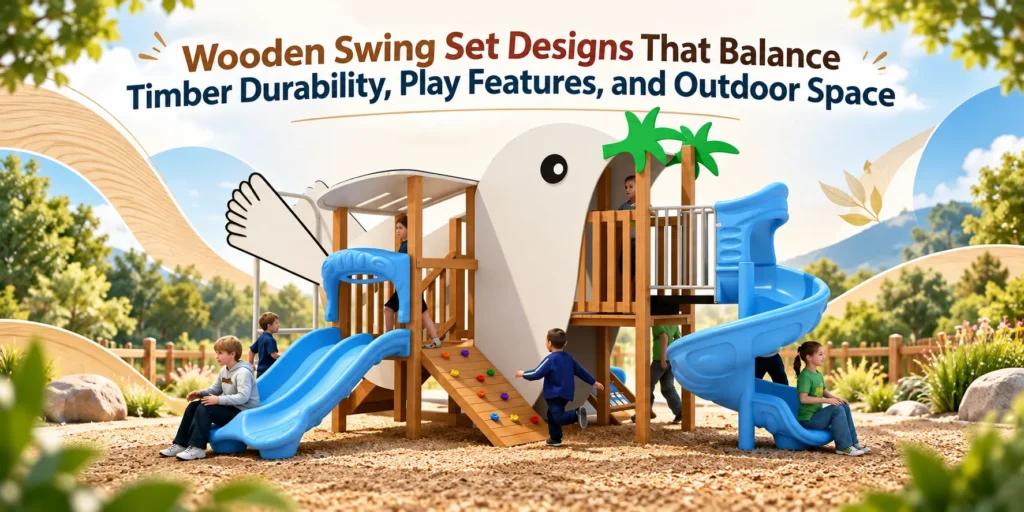
A back garden, a school playground, or a community plot needs play equipment that survives years of weather and daily use. Buyers comparing wooden swing set options face two questions early: which timber, and which configuration actually fits the space?
A wooden swing set is an outdoor play structure built from timber — commonly cedar or pine — combining a support frame with swings, slides, climbing walls, or play decks, and sold in fixed catalogue builds or customised layouts.
Distributors, school contractors, and OEM buyers usually shortlist by configuration first, then timber.
Wooden Swing Set Configurations Across Supplier Catalogs
Catalogues usually sort wooden swing sets by play pattern first. Cedar and pine variants dominate listings, but the naming splits into three groupings:
- Swing-only frames: belt swings, baby seats, gliders, and trapeze bars on a two- or three-bay A-frame. Supplier pages often label these “swing sets” or “swing stations”.
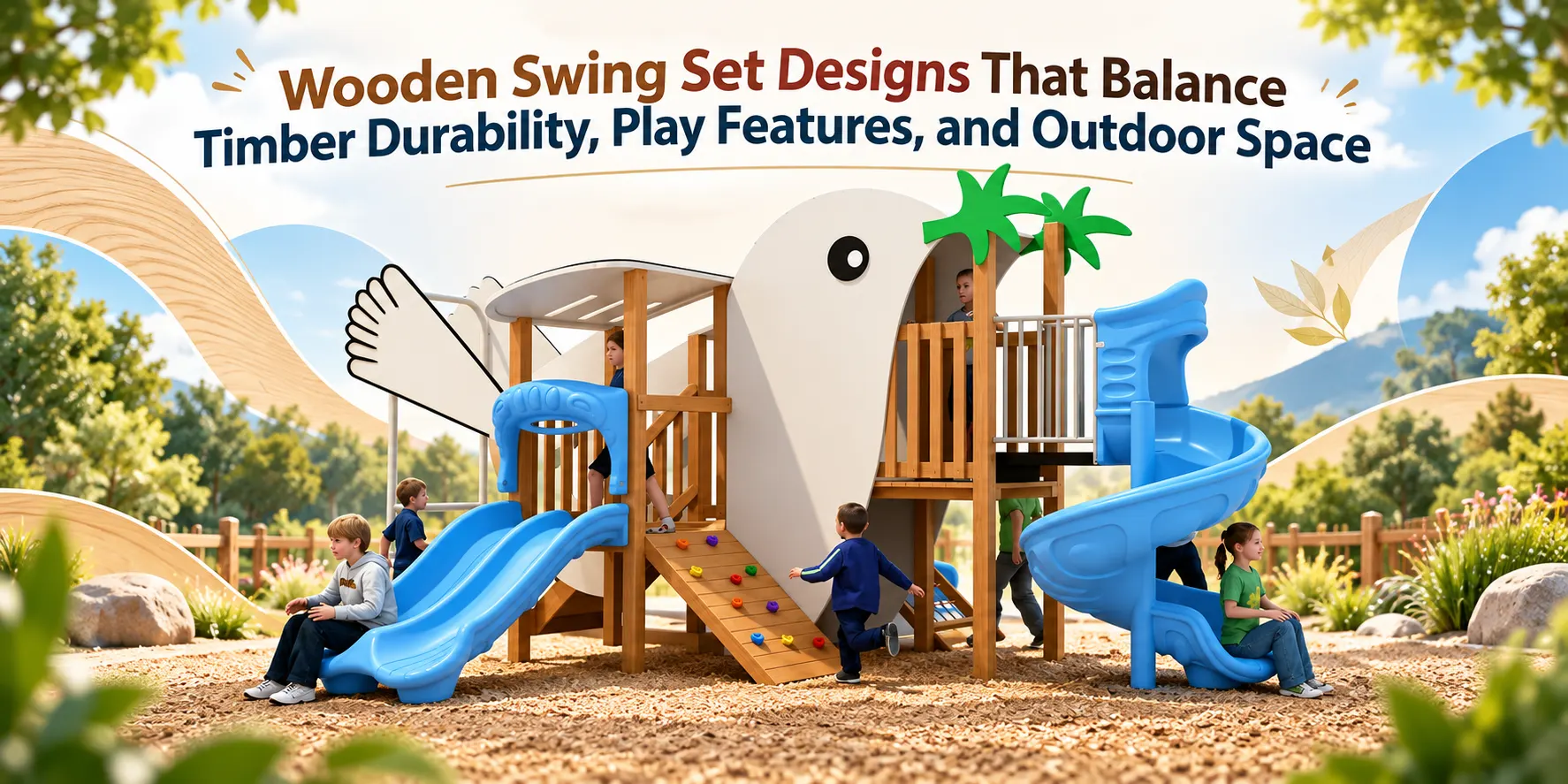
- Play deck sets: an elevated platform with a canopy or fort roof, plus one or two slides and a rock wall ladder. Listings call these “play decks”, “forts”, or “clubhouses”.
- Combo playsets: playhouse base, wave slide (often a wavy or scoop style), climbing wall, and overhead bridge. Suppliers group them as “playhouse combos” or “multi-level playsets”.
A kids playground equipment manufacturer and school playground manufacturer normally publish these categories as filter tags, so buyers compare roof, slide, and swing counts before requesting quotes. Timber grade drives the next comparison.
Material and Build Specifications That Separate Cedar, Pine, and Finished Wood Swing Sets
Spec sheets settle material questions faster than photos. Two grades dominate supplier listings, and they differ in maintenance terms rather than assembly.
| Spec signal | Cedar | Southern Yellow Pine |
|---|---|---|
| Rot resistance | Natural oils resist decay; no chemical treatment needed | Relies on pressure treatment or factory stain |
| Finish behaviour | Soaks up stain unevenly; greys within two seasons if left bare | Denser grain holds factory-applied exterior stain longer |
| Typical outdoor use | Premium residential sets, playhouse panels, roof trim | Load-bearing frames, decks, high-traffic school units |
Construction details to verify before shortlisting a wooden swing set source:
- Timber origin stated as American-grown, with the species named.
- Handcrafted or Amish-style builds usually mean mortise-and-tenon joints, sanded edges, and countersunk bolts rather than exposed lag screws.
- Factory-applied stain across two coats, not a single dip.
- Deck boards sanded on both faces to reduce splinters.
Timber grade sets the floor of each price tier, which is where size and feature decisions start.
Wooden Swing Set Price Tiers, Sizes, and Feature Levels in the Market
| Tier | Approximate footprint | Feature count | Typical buyer |
|---|---|---|---|
| Entry / simple set | 8–10 ft, 2 swing positions | 1–2 stations, no slide | First backyard purchase |
| Mid-range | 11–14 ft, single tower | 3–4 stations, slide, rock wall | Families, small kindergartens |
| Large multi-feature | 15 ft+, two or more towers | 5+ stations, play deck, fort, playhouse | Community developments, kindergarten chains |
For a wooden swing set, each step up is driven by material volume and assembly time, not the accessory list. A mid-range set carries roughly 30–40% more timber, a taller deck and a slide, lifting freight and labour together. Large playsets stack two or more towers, so hardware counts and installation hours climb again.
Compare three signals: deck height, swing positions, and whether the slide and climbing wall are included or optional. Two sets of similar footprint can differ by several thousand dollars on those points alone. Fixing size and feature counts early keeps tier comparisons honest for an OEM kids playground manufacturer quoting a multi-unit project.
Custom and Private-Label Wooden Swing Set Programs for Volume Buyers
Private-label and OEM programs let you specify the set rather than buy from stock. Customisation pages list what can change; catalogs show one frame sold under several brand names with different roofs, slides and finishes. Buyers acting as a kids outdoor playground manufacturer often need that frame repeated across finishes and layouts.
- Roof styles: flat, gable, tower or canopy
- Slide types: wave, straight, spiral or tunnel
- Swing configurations: belt, baby seat, trapeze, two to four positions
- Play deck layouts: single platform, multi-level, fort or playhouse add-on
- Finish colours: natural cedar, factory stain or painted range
Three risks decide whether a programme holds up. Design consistency: confirm the same drawings and hardware carry across reorders. Replacement parts: check how long brackets, swing hangers and slide sections stay available. Order documentation: drawings, spec sheets and colour references should match what arrives.
Those choices then map onto backyard, school and community settings.
Matching Wooden Swing Sets to Backyards, Schools, and Community Play Areas
The same wooden swing set entry rarely suits every site. Supplier application pages sort playsets by where they stand: a fenced garden, a kindergarten yard, a primary school field or a shared community green. Footprint, swing-bay count and access routes shift with each. Age-zone playground design language usually appears in the same listings, next to the setting labels.
| Setting | Typical footprint | Age focus | Feature priorities |
|---|---|---|---|
| Backyard | 2.4–3.7 m wide | 3–10 | Belt swings, wave slide, compact play deck |
| Kindergarten | 3.7–4.9 m wide | 2–5 | Low platforms, step ladders, clear sightlines |
| School yard | 4.9–7.3 m wide | 5–12 | Higher decks, rock wall ladder, multi-bay beam |
| Community play area | 7.3 m and above | Mixed | Fort, playhouse combo, separated access routes |
- Leave roughly 2 m of clear space in front of and behind each swing bay, plus side room for a slide run-out.
- Keep toddler and junior zones apart so travel paths never cross beneath moving swings.
- Each belt swing bay seats one child, so a three-bay beam serves three at a time. A school with 60 pupils at break needs staggered rotas or several frames.
Fix the setting first; every later choice narrows from there.
About JQ Playground – kidsplaygroundmanufacturer.com
JQ Playground (Wenzhou Jiqi Amusement Equipment Co., Ltd.) is a children’s playground equipment manufacturer founded in 1993. The company provides design, customization, large-scale manufacturing, sales, installation guidance, and after-sales support for outdoor playgrounds, indoor playgrounds, soft play, water playgrounds, PE board playgrounds, kindergarten furniture, outdoor fitness equipment, pet playgrounds, and playground facilities. Approved company facts include 180+ employees, a large Wenzhou production base, 20+ production lines, 55 production machines, ISO/BSCI/EN1176/EN71/ASTM/CPC/CPSIC certification references, 100+ patents, free design support, OEM/ODM capability, trial installation before shipping, export experience, and one-year quality warranty.